“If you are silent about your pain, they’ll kill you and say you enjoyed it.”― Zora Neale Hurston
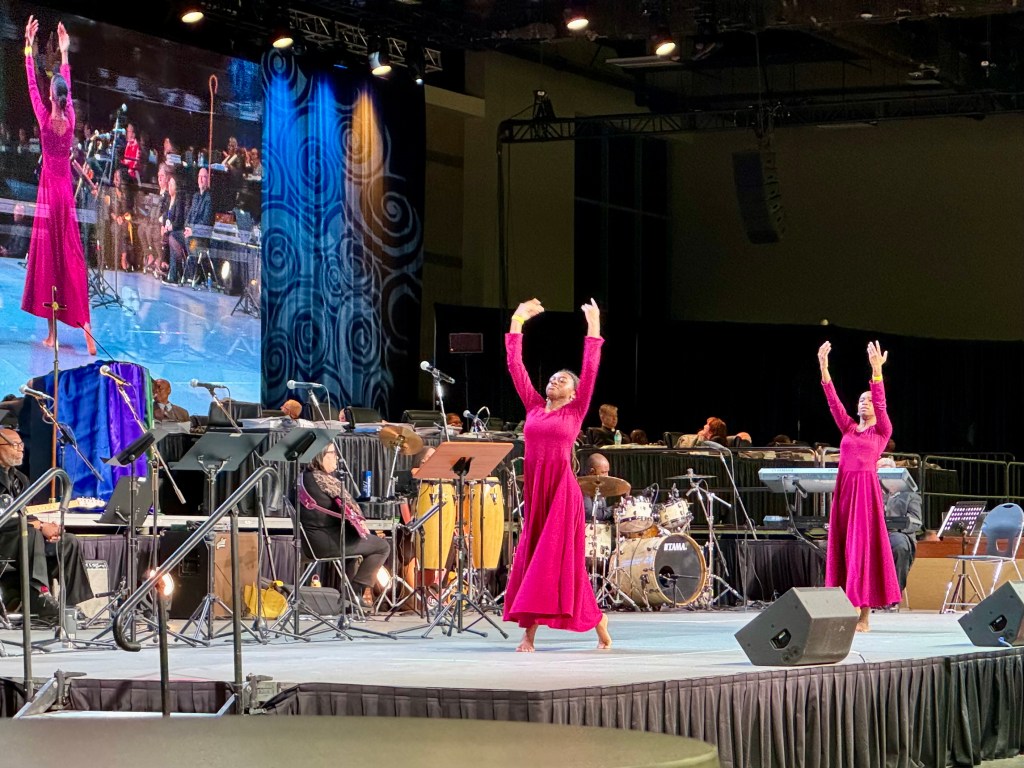
Today began with a time of worship, at the heart of which was a powerful, sharply prophetic, and rightly unsettling proclamation by Bishop LaTrelle Easterling, focusing on the sins of abuse and sexual violence, particularly where such violence has occurred in the church’s ministry or with the church’s complicity. Today (Thursday) is “Thursday in Black” at General Conference, envisioned and developed by the United Methodist Church’s General Commission on the Status and Role of Women along with the World Council of Churches.
“Thursday in Black” is a unique opportunity for General Conference delegates to remember those who have experienced or are experiencing abuse and sexual violence; to honor their resilience; to repent of complicity; and to commit to the ongoing and perpetually urgent work of naming, condemning, and addressing abuse and sexual violence as being wholly antithetical to God’s deepest desires and intentions for the human community. Said Bishop Easterling this morning, “we practice hypocrisy if we focus only on the victims’ resiliency without acknowledging the church’s complicity through silence and inaction concerning abuse and violence against the most vulnerable in our midst.”
Bishop Easterling’s words inspired me to remember a song written by Dua Lipa entitled “Boys Will Be Boys,” some of the haunting lyrics of which are these:
It’s second nature to walk home before the sun goes down
And put your keys between your knuckles when there’s boys around
Isn’t it funny how we laugh it off to hide our fear?
When there’s nothing funny here
Sick intuition that they taught us so we won’t freak out
We hide our figures doing anything to shut them out
We smile, a way to ease the tension so it don’t go south
But there’s nothing funny now
Boys will be
Boys will be
Boys will be boys
But girls will be women
It was a sobering service of worship this morning, reminding delegates of the truth that “love and abuse cannot coexist” (bell hooks).
Following this beginning to the day, delegates experienced an engaging Laity Address offered by LaToya Redd Thompson, John Hall, Jennifer Swann, Mele Maka, and Micheal Pope. In the unfolding of a General Conference, the Laity Address serves as a tangible reminder that, if revival is to occur in the church, it will not come primarily through the clergy. Rather, it will come through the ministry of gifted and called lay persons who, to borrow the language of today’s address, become “disciples in the home, the neighborhood, the workplace, and the marketplace.”
The rest of the morning plenary session led us into significant, even historic legislative work. The most noteworthy portion of this work was the General Conference’s approval by consent of 4 of the 8 petitions calling for the worldwide regionalization of the United Methodist Church. Later in the morning, we passed a fifth and the most foundational petition concerning regionalization. Since this fifth petition calls for an amendment to the United Methodist Constitution, it required a two-thirds majority to pass. The legislation passed 78% to 22%. While regionalization of the church has come up before at General Conference, the legislation never gained comprehensive traction. Today’s vote indicates a new mindset and spirit in the General Conference.
What is the significance of regionalization to the denomination? Many—me included— believe that regionalization is the church’s best hope for strategically contextualizing its ministry in a manner that recognizes the unique and diverse missional needs and priorities of the various regions of the global church. There was a time when the United Methodist Church outside of the United States, early in its existence, consisted of several global mission posts. Today, what may have begun as “mission posts” are now vital and vibrant portions of United Methodism that have outgrown the U.S.-centric polity that the denomination has embraced for decades. The plan for regionalization, in this regard, is an effort to decolonize United Methodism by creating four regional conferences (Africa, Europe, Philippines, and the U.S.), all possessing the same means by which to pass legislation for greater missional impact without having to wait for the work of the quadrennial General Conference.
Here is a link to more information about regionalization and what transpired today:
https://www.umnews.org/en/news/regionalization-gets-general-conference-go-ahead
Because this legislation involves amending the United Methodist Constitution, it will also need to be ratified by a two-thirds total vote of annual conference lay and clergy voters (which will be on Annual Conference agendas throughout 2024 and 2025). Regionalization, therefore, is not a done deal. Today, however, was a critical step in its realization.
Speaking of the global church, there was a particularly tender and painful moment in this morning’s plenary. The delegates, by a vote of 672 to 67, approved the departure of four Eurasion annual conferences, which include 66 churches in Russia, Belarus, Kyrgyzstan and Kazakhstan. The four conferences have plans to work together to form an autonomous Methodist Church. Bishop Eduard Khegay, who is also leaving the denomination, offered a gracious expression of gratitude to United Methodism for its ministry in his life and in the life of the churches under his episcopal leadership.
We spent the afternoon in our various legislative sections, caring for the petitions and resolutions assigned to each section. In my legislative section (Global Ministries), we approved a variety of important racial-ethnic ministry plans, which will go onto the consent calendar. We also approved a petition calling for our denominational boards and agencies to provide more opportunities for training and resourcing related to the development of “cooperative parishes”—of particular interest to me, since the church I now serve (along with every church in the New York Annual Conference) is part of a cooperative parish.
It has been an important day three at General Conference, friends. I am grateful to have experienced it, and grateful for your continuing prayer and encouragement.
Peace.
 A Gracious Graffiti