General Conference: Day Two

(Photo by Mike DuBose, UM News)

“The church was never built for our pleasure,” declared Bishop Jonathan Holston in his Episcopal Address during this morning’s plenary session. “Rather, the church was built for God’s purpose.”

After a centering time of morning worship today, Bishop Holston offered what I experienced as a rousing and insightful address on behalf of the Council of Bishops. Through both video segments and spoken narrative, the Bishop presented a sensitive overview of some of what has transpired over the last eight years in both the world and the ministry of the United Methodist Church: pandemic and isolation; political division and ecclesiastical schism; technological advancement and cultural achievement; horror and hope; weeping and rejoicing; death and life. Through it all, the United Methodist Church has continued to incarnate its mission to make disciples of Jesus Christ for the transformation of the world. Through several inspiring stories of the church at its very best, Bishop Holston reminded us that our denomination is still vibrantly and globally working to alleviate hunger, to care for the displaced and despondent, to generate hope among those who suffer, and to bring both the socially well-situated and the painfully marginalized into the reconfiguring grace of Jesus. The Bishop’s address both comforted me in my places of discouragement and unsettled me in places where I have become inappropriately comfortable. “When was the last time you led someone to Christ,” the Bishop inquired of those present. “And when was the last time you made a witness to Jesus through your life and decision-making?” I am still living with his questions as I reflect on what it will mean to become a church that, as the Bishop put it, “becomes a vibrant and continuing sign of God’s beautiful reign in the world.”

Following the Episcopal Address, delegates received a series of reports, the presentation of which led to the adoption of a General Conference agenda. We now have a clear sense of how we will be stewarding both our work and our time.

The rest of the morning plenary session included some important presentations:

A Report on the Revision of the Social Principles

What are the Social Principles? In short, the Social Principles are United Methodism’s thoughtful effort to speak to a wide variety of issues in the contemporary world from a sound biblical and theological foundation. In existence since 1972 and expanded significantly by every General Conference since, the Social Principles, while not considered church law, are an instructive guide for United Methodists as they endeavor to navigate often-complex social issues with both spiritual depth and ethical attentiveness. Later on in the General Conference, delegates will debate and take action on a revised collection of Social Principles, prepared and submitted by a global team of theologians and theological voices—both laity and clergy. The purpose of the revision of the Social Principles, according to today’s overview, is “to offer to the church a clearer, more concise, more deeply theological, and more authentically global resource.”

Here is a link to the revised Social Principles upon which the General Conference will be taking action:

https://www.umcjustice.org/documents/124

The Young People’s Address

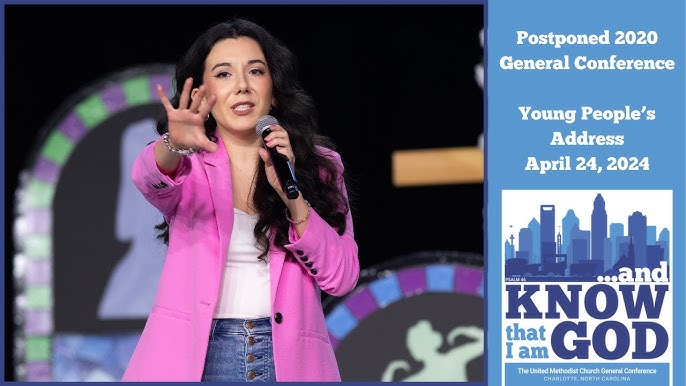
As  a quadrennial exclamation point upon United Methodism’s commitment to young people, General Conference includes a Young People’s Address, the purpose of which is to amplify the voices and illuminate the perspectives of those United Methodists between the ages of 18 and 35. Today, Alejandra Salemi from the Florida Annual Conference and Senesie T.A. Rogers from the UMC in Sierra Leone offered an address that was both stirringly poignant and pointedly challenging. From the deep hearts and the articulate voices of these two young disciples, I heard the naming of pain and anxiety produced by both a divided nation and a divided church—an anxiety that Salemi equated to the anguish of a divorce. I also heard in their words a profound challenge to become a church that is far more passionate about the love of Jesus than it is about resentment that leads to contempt. Said Rogers, “reconciliation and coming together is part of our tradition. We must be more about uniting than dividing at this point.” 

A Report on the General Book of Discipline

As part of a larger conversation about the global regionalization of the United Methodist Church’s ministry (about which the General Conference will be making important decisions over the next ten days), delegates heard a presentation today about a proposed General Book of Discipline that would make certain portions of the Discipline more adaptable, thereby (according to the crafters of the legislation) allowing the various global regions of the church to structure mission and ministry in a manner that is most contextually appropriate and strategic. Envisioning a longer process of development, today’s presenters called for each region of the church to develop a means by which to review the proposed General Book of Discipline and offer feedback. While the denomination’s doctrinal standards remain unadaptable in this proposed Discipline, the hope behind the proposal is that the adaptable portions will make the UMC less US-centric and US-dependent in its polity and structure.

Reports on the Financial State of the Church and the Pathway to Our Next Expression

The General Council on Finance and Administration has proposed to the General Conference a quadrennial (2025-2028) denominational budget of approximately $353 million. This marks a nearly 42% reduction from the denomination-wide budget that General Conference approved at its last regular meeting in 2016, reflecting the impact of disaffiliation and the pandemic on the denomination. While this is sobering news, to be certain, the Council of Bishops and the Connectional Table voiced their commitment to the work of crafting a continuing vision for the church that we are becoming—a smaller church, but one that is uniquely poised for mission and ministry.

After lunch, delegates moved to their legislative sections that met in various rooms throughout the Convention Center. The agenda for each legislative section meeting was to elect section leaders and to organize the section for its legislative work. Here is a brief explanation of the legislative sections and their function: To care for the large volume of legislative proposals submitted to General Conference, each General Conference delegate is assigned to one of fourteen legislative sections. All the legislative proposals are divided among these legislative sections for discussion, debate, amendment, and, ultimately, action. If there are no more than 10 votes against a prevailing vote on a petition or resolution in a legislative section, it goes onto a daily consent calendar (along with many other petitions and resolutions approved by the various legislative committees). The entire daily consent calendar will then come before the plenary session of General Conference for a final vote. 

I am in the Global Ministries legislative section. We elected our section leaders and organized ourselves for the pieces of legislation that we will be addressing over the next few days. Tonight, I am rereading my section’s legislation so that I might be prepared for tomorrow’s work.

There you have it, friends—a full day two of General Conference.

If you made it to the end of this post, thank you. I am grateful for your interest and your prayers.

(Photo by Mike DuBose, UM News)

General Conference: Day One

Samuel Taylor Coleridge once wrote, “the ones who are best prepared can best serve their moment of inspiration.”

Today was a day of both preparation and inspiration for General Conference delegates. We spent the morning in a time of helpful training, offered by well-prepared leaders and officers. We learned about the General Conference rules and the parliamentary procedure by which we will operate, so that delegates might be ready to engage with our future legislative work in an informed and consistent manner. We learned about the various General Conference teams and committees so that we might better understand the particulars of our processes and procedures. We also trained on our electronic voting devices so that we might utilize them skillfully during deliberation and voting. (Holding my electronic voting device today inspired a smile or two over the remembrance of the handheld colored placards with which we used to vote at General Conference. Technology has made it a much different process, to be certain.)

Following lunch came some spiritual inspiration in the form of opening worship. Because of the pandemic, it has been five years since I have worshiped with a truly global congregation of United Methodists in a setting of the general church. Hearing the many robust voices joining together in hymns of praise and prayers of thanksgiving inspired within me both a freshly warmed heart and tears of gratitude. Bishop Thomas Bickerton preached a truly evocative and inspiring sermon, clearly and truthfully naming some of what we have gone through as a denomination over the last four years while also casting a bold vision for the reconfigured, revived, and mission-driven church we are becoming. It was the kind of sermon that established a deeply hopeful tone for this General Conference and life beyond it. 

After the opening worship, the General Conference was officially called to order and we experienced our first plenary session during which we cared for preliminary organizational matters, including the adoption of our now-amended and perfected Plan of Organization and Rules of Order. To put it simply, before any General Conference can officially do its extensive work, it has to agree on the means and methodology by which it will accomplish that work. We successfully approved the rules and processes that will provide both structure and accountability throughout General Conference. 

The day concluded with a 6:30 dinner, from which I just returned.

At one point in the day, I had some conversation with a group of volunteers who have come to Charlotte on their own dime and time to volunteer at General Conference. They had nothing but words of gracious encouragement for me. Throughout the morning and afternoon, I received over twenty texts and e-mails from people in Western Pennsylvania and New York letting me know that they are holding me (and us) in fervent prayer. I cannot put into words how life-giving it is to my spirit to know that so many people are praying. It makes prayer feel less like an activity and more like a sanctified communion of manifold souls.

Between lunch and opening worship today, I found a quiet and empty banquet room in a back hallway where I could experience a few moments of solitude—something important for this introvert to do periodically, especially in a conference where people are almost everywhere. During my moments of solitude, I rewrote one of my past prayers, contextualizing it specifically for day one of this General Conference. After writing it down, I prayed the words out loud this afternoon, simply for the purpose of allowing my heart to be shaped by its petitions.

This was my prayer:

Holy God—Father, Son, and Holy Spirit—who both transcends time and occupies it; who is intimately present with us in both our solitude and our conferencing; who has built the church on the rock of a grace-shaped faith, and who will preserve the church so that not even the power of death will prevail against it:

We have prayed and pondered for many months, and now we come together…

Many voices;

Many perspectives and temperaments;

Many different hopes, fears, and longings;

But with hearts joined in a common love for Jesus and the ministry of his beautiful church.

We come with a spirit of repentance, depending wholly on your reconfiguring grace that is always greater than our sinful rhythms and our distorted priorities.

We come in a spirit of vulnerable availability, eager to hear and to be heard; to see and to be seen; to love and to be loved.

Come, Lord Jesus.

Come, be the center of our discernment and our deliberation.

Come, be the thoughts that we think, the words that we speak, the air that we breathe.

Come, Lord Jesus.

Come, be the window through which we see one another differently; through which we recognize one another’s sacred worth; through which we glimpse what your church can be at its most vibrant.

Come, Lord Jesus.

Come be the Window, the Word, and the Way.

Come, Lord Jesus.

Amen.

I share this prayer with you here in the hope that it will deepen your spirit of intercession. Thank you for reading this post. And please, friends, keep praying.

Preparing For the United Methodist Church’s General Conference: The Day Before

I am currently in Charlotte, North Carolina, prayerfully focusing my thoughts and softening my heart for the work of the United Methodist General Conference which begins tomorrow (Tuesday). 

If you are someone who has completely lost interest in denominational Christianity, and if current bureaucratic denominational realities either frustrate you or bore you to tears, believe me, I completely understand. Yet, since United Methodism remains a unique and beautiful portion of the body of Christ, it is important for those who love the ecumenical church to pay attention to what transpires in the ministry of its various denominations.

From April 23 through May 3, the United Methodist General Conference, to which I am an elected clergy delegate, will be in session at the Convention Center in Charlotte, North Carolina. What is the General Conference? It is a gathering of 862 elected delegates, which includes an equal number of clergy and lay delegates (431 of each). There will also be thousands of in-person guests, observers, interpreters, and volunteers. The 862 delegates come from all around the world, wherever United Methodism exists, and are elected by their particular regions. 482 of the delegates are from the United States. 278 are from Africa. 52 are from the Philippines. 40 are from Europe. 10 are from concordat Methodist churches in the Caribbean, Great Britain, Mexico, and Puerto Rico.

The General Conference, which normally meets every four years, is the only body that can establish policy and church law for the United Methodist Church.

Having been a part of five General Conferences throughout my ministry, I know from experience that there will be many different types of dialogue at General Conference. Much of that dialogue will be rich with hope and joy concerning new initiatives in the denomination’s ministry with young people, older adults, immigrants, and the poor. We will discuss new developments in United Methodism’s efforts to equip leaders, dismantle poverty, eradicate racism, transform lives, and bring souls into relationship with Jesus. We will also consider the possible regionalization of the denomination’s global ministry and whether such regionalization will help the global church to become more strategic and missional in both its structure and impact.

Sadly, there will also be some heartbreaking dialogue about division and disaffiliation, much of which will revolve around the denomination’s continuing and often-traumatizing debate over what to say, teach, and embody concerning human sexuality in general and homosexuality in particular—a debate that has occupied the emotional energy of every General Conference since 1972.

I know many LGBTQIA+ persons who feel particularly vulnerable in these matters, perhaps because of past trauma or because of too many heartbreaking struggles to feel fully accepted and valued in the church for the entirety of who they are. If I am describing you, please know that I hold you deeply in my prayerful heart as the long and important days of General Conference begin. Your faces in my thoughts are a vital portion of my inspiration to continue in this work. You do not stand alone in your pain, nor do you walk alone in your desire for a church that reflects more vibrantly the gracious and welcoming heart of God.

I invite those of you who care deeply about these matters, particularly those of you who are United Methodist, to engage in three specific disciplines. First, stubbornly resist the temptation to become cynical or resentful about the work of General Conference, especially if people attempt to take you down a toxically negative road. In my experience, a spirit of cynicism and resentment often leads to a heart that is cold, a temperament that is dismissive, and a discernment that is clouded by a distorted sense of absolute certainty. The United Methodist Church deserves better than that.

Second, be intentional about reminding yourself and others that the United Methodist Church’s difficult conversations about everything from human sexuality to regionalization—everything from the Social Principles to the particulars of disaffiliation—are not debates between people who love Jesus and people who don’t, or between people who believe in the Bible and people who don’t. Rather, the disagreements at General Conference are most often between devoted Christ-followers who have come to significantly different conclusions about how parts of the Biblical narrative are to be interpreted, honored, and applied. Remembering this can help us avoid the temptation to demonize those who are on the other side of a debate, even when we are convinced of their wrongness.

Third, pray without ceasing. Dare to believe that prayer is a sacred and mystical conduit through which the redemptive activity of God makes its way into human circumstances, sometimes transforming the circumstances and other times reconfiguring human hearts so that the circumstances can be more creatively managed. I am inviting you to believe in the power of prayer with me and to pray urgently for the United Methodist Church and its General Conference. Pray for the Western Pennsylvania delegation of which I am a part and all the delegations. Pray for the Bishops as they preside. Pray for the safe travels of all who will be making their way to Charlotte. Pray for all who are volunteering their very best time and energy to make the Convention Center as hospitable an environment as possible. Pray that people will treat one another with respect and patience, even when emotions run high. Pray for the protection of tender hearts and the nurturing of right priorities. Most of all, pray that the Holy Spirit will flow through the complicated rhythms of General Conference thereby helping the United Methodist Church to bear steady witness to the always-beautiful heart of God.

I am grateful to be part of a church that refuses to turn away from hard and important conversations. Likewise, I am humbled to be part of a church that believes that Jesus does good and redemptive work, even in the messy, potential-rich, and transformative conferencing of his people.