Don’t Forget to Play

playing-kid-1436468-640x480 (1)

There is something deeply enlivening and holy about the spiritual discipline of play.  Sabbath-rich play is often where we become our most authentically human.  This song is about that very thing.  Thanks for playing along.

Play (Words and music by Eric Park)

Long ago when God rested on the 7th day

It wasn’t time for sleeping or a holiday

Maybe it was a day to soak up the newborn sun

A playful recreation in the light of what he’d done


If we’re made in the image of this kind of God

This working, playing, moving, resting kind of God

Then deep within our soul we find a common way

A healthy rhythm making room for work and play


And don’t forget to play

It’s part of what’s inside us

Don’t forget to play

It limits what divides us

Don’t forget to play

There’s laughter right beside us

No better time for playing than today

Join the recreation, come and play

 

Stifling our playfulness is nothing new

It’s looked upon as slothful when there’s work to do

But even work is playful when it’s done with grace

A playful spirit softens up a hardened place


And don’t forget to play

It’s part of what reveals us

Don’t forget to play

Removing what conceals us

Don’t forget to play

It unifies and seals us

No better time for playing than today

Join the recreation; come and play


It’s what keeps my spirit light

Keeping things within me bright

It’s what brings me off the shelf

And helps me be my truest self


A soul deprived of playtime in time will long for more

It’s part of why we nurse the sick and feed the poor

Reaching to the broken souls that they might be

Brought closer to a playfulness that sets them free


And don’t forget to play

It’s part of what reveals us

Don’t forget to play

Removing what conceals us

Don’t forget to play

It unifies and seals us

No better time for playing than today

Join the recreation; come and play


And don’t forget to play

It’s part of what’s inside us

Don’t forget to play

It limits what divides us

Don’t forget to play

There’s laughter right beside us

No better time for playing than today

Join the recreation, come and play
 

A Litany for Father’s Day

lessons-of-life-1-1573443-639x426 (1)

A Litany for Father’s Day

Always-parenting God, we cry out to you with a prayerful heart on behalf of our fathers.

Where our fathers have blessed us with their faithfulness, integrity, and love, deepen our gratitude.

LET OUR PRAYERS BECOME A SONG THAT PLEASES YOUR HEART.

Where our fathers have wounded, mistreated, or abandoned us, deepen our healing and forgiveness.

LET OUR PRAYERS BECOME AN EXPERIENCE OF YOUR EMBRACE.

Where children and fathers are alienated from one another, deepen either our reconciliation or our acceptance of necessary distance.

LET OUR PRAYERS BECOME INSTRUMENTS OF RECONCILIATION, ACCOUNTABILITY, AND PEACE.

Where good men have never been called to be fathers, or have never been given the opportunity to raise children, deepen the fatherly role they play in the lives of many.

LET OUR PRAYERS BECOME AN ENCOURAGEMENT TO ALL MEN AND AN ILLUMINATION OF THE CRITICAL ROLE THEY PLAY IN YOUR STORY.

Where fathers are grieving over the loss of their children and children over the loss of their fathers, deepen our awareness of your weeping and redeeming presence.

LET OUR PRAYERS BECOME THE CHANNEL THROUGH WHICH YOU MAKE YOUR WAY INTO OUR DEEPEST PAIN.

Where fathers are committed to loving their children comprehensively and raising them in a spirit of vulnerability, devotion, and gentleness, deepen the joy and purpose they find in fatherhood.

LET OUR PRAYERS BECOME A GRATITUDE THAT IS DEEPER THAN OUR WORDS.

Where fathers and children are struggling in relationships that feel broken, depleted or dysfunctional, deepen our shared compassion and encouragement.

LET OUR PRAYERS BECOME PART OF THE HEALING THAT YOU OFFER TO WOUNDED SOULS.

On this Father’s Day, engage us in a more dynamic communion with your holy presence, where fatherhood always finds its origin, its meaning, and its redemption. We pray this in the name of Jesus, whose perfect relationship with the Father is the source of our deepest hope. AMEN.

In the Aftermath of Orlando’s Atrocity

os-orlando-shooting-pulse-nightclub-20160612

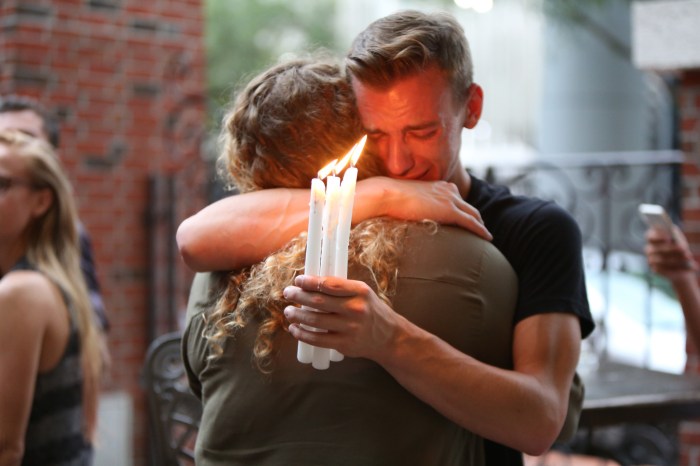
In the aftermath of Sunday’s mass shooting in Orlando, Florida, I am joining many of you in a heartfelt lamentation over many things: The violent and senseless ending of 49 precious and potential-rich lives; the heartache of grieving friends and family members who find themselves longing for just one more conversation with those voices that will never again be heard; the tendency to dishonor our collective grief by burying it under a bitter debate over things like sexual morality or gun control.

There is another lamentation, too frequently unnamed, that resonates somewhere in the hidden chambers of my hurting soul. It is a lamentation over humankind’s tragic tendency to allow distorted religious conviction to become a fuel for toxic hatred and unbridled savagery. Upon reading that last sentence, many will immediately call to mind radical Islam and its penchant for acts of terrorism. To be certain, violence grounded in a distorted expression of Islamic theism is a threat that the entire world must take seriously.

I am every bit as concerned, however, about various manifestations of hatred and cruelty that are grounded, not in Islamic fundamentalism, but in an equally distorted brand of Christian fanaticism. (The word “fanatic,” interestingly, has its roots in the Latin word “fanaticus,” which can be translated “insanely responding to a misunderstood deity.”) Consider these words recently preached by a Christian pastor in northern California whose name and whose church’s name I prefer not to include. (I will say only that the church describes itself as an “independent, fundamental, soul winning, separated, King James Bible believing church”):

People say, ‘Well, aren’t you sad that 50 sodomites died?’ Here’s the problem with that. It’s like the equivalent of asking me, ‘Hey, are you sad that 50 pedophiles were killed today?’ Um, no. I think that’s great. I think that helps society. You know, I think Orlando, Florida is a little safer tonight. The tragedy is that more of them didn’t die. The tragedy is—I’m kind of upset that he didn’t finish the job…I wish the government would round them all up, put them up against a firing wall, put a firing squad in front of them, and blow their brains out.

Another pastor from Arizona posted the following comments in a recent YouTube video:

The Bible says that homosexuals should be put to death, in Leviticus 20:13. Obviously, it’s not right for somebody to just, you know, shoot up the place, because that’s not going through the proper channels. But these people all should have been killed anyway, but they should have been killed through the proper channels. As in, they should have been killed by a righteous government that would have tried them, convicted them, and saw them executed.

The Christ-followers I know, even the ones who hold strong convictions about what they believe to be the sinfulness of homosexual practice, would loudly repudiate such teachings. The fact that such teachings exist within the body of Christ, however, makes clear that Islam does not hold a theological monopoly on religious hatred and violence.  I do not mean to suggest a direct comparison between Christianity and Islam in this regard, since such a comparison would no doubt invite an unwanted and unnecessary debate. What cannot be debated, however, is that Christianity is no stranger to various shades and gradations of the hatred articulated by the pastors quoted above. History is all-too-peppered with examples of the name of Jesus being co-opted by determined souls with malicious agendas.

How, then, do I want to respond in the aftermath of the Orlando mass shooting? How do I want to live in a world where people so frequently allow their religion to become an unholy fuel for rigid dichotomies and pathological animosity? Those are questions that I continue to ponder in deep prayer, with sighs too deep for words. Here is what I am discerning thus far:

  1. I want to live with the kind of heart that always grieves deeply and abundantly over human atrocities, never becoming desensitized to the suffering they engender.
  1. I want to have a heart for the kind of justice that values and protects the personhood and sacred worth of all people, including the people whose politics, sexual ethics, and religious convictions are vastly different than mine.
  1. I want to have meaningful conversations about gun control laws without settling for distorted extremes. One distorted extreme tends to place an exaggerated hope in the possibility of stricter gun laws. The other tends to elevate the rights of individual gun-owners over the potentially greater common good. Neither extreme is where I want my outrage over human atrocities to find its deepest expression.
  1. I want to form the kind of relationships with people (including LGBTQ people) that help them to understand that the church is not their enemy; that the church fully recognizes the sacredness of their personhood; and that the church is far more eager to love than it is to ostracize.
  1. I want to pursue Scriptural holiness in a manner that cultivates respect rather than contempt for the various and divergent portions of the human community.
  1. I want to be an agent of forgiveness, repentance, accountability, peace, and reconciliation in all of my relationships, so that the peaceable kingdom that Jesus came to inaugurate will find expression in the stewardship that I practice over my engagement with life and community.
  1. I want the saving and sanctifying grace of Jesus to occupy my journey so substantially and so transformationally that there is no room left for anything that does not bear witness to the Way he values, the Truth he embodies, and the Life he offers.
  1. I want to live as though I truly believe that the heart of God breaks and bleeds over human suffering; that Jesus weeps when human beings choose to hate and harm one another; and that the God who fashioned the universe finds his way into the nooks and crannies of our horrendous tragedies.

Where was God when the gunfire began in the wee hours of Sunday morning? God was right there, in the heart of that nightclub. God was right there, in the thick of it all, feeling the agony of every gunshot wound; sharing the anguish of every tear; hearing the desperation of every panicked outcry; weeping over the sadness of every tragic death. Because that is who God is. Intimate. Personal. Vulnerable. Emotional. Incarnational. Wounded. Broken. Crucified.

Then, when the weeping stops for a while, God will still be right there, gradually but steadily leading a devastated people into a new season of hope and redemption—leading people out of death into new life.

That, too, is who God is.

A Lament (What Do I Make of You?)

Fifteen years ago, at the end of May, 2001, Anthony Rivetti, Tara’s father and my father-in-law, died after a hard journey with cancer. He was a man of deep integrity, fierce devotion, and winsome hospitality. I wish all of you could have known him.  Every day, Tony’s presence in the world is dearly missed.

A couple of months before Tony’s death, I sat at the piano, which is where I frequently go when I am confronted by things that I cannot easily accommodate in my spirit.  Strangely, as my fingers touched a variety of keys, I began to think about what I would say to cancer if cancer were personified–if I were able to converse with cancer the way I would a person.  At the time, it was a spontaneous means by which to give expression to my ever-deepening grief.  Those thoughts, combined with the notes I was playing, eventually became a song of lament.

On the fifteenth anniversary of Tony’s death, I share the song here, hoping to honor both his memory and his legacy, and hoping to remind myself–and perhaps others–that cancer and death, while bitter and painful, are never given the final word to speak.

Lament (What Do I Make of You?)–sung by Tara and Eric Park

Frailty interrupts a life with whispering voice

Unceremonious, waits not for one’s choice

All delusions of invincibility

Fade like flickering dreams not meant to be


You’ve been among us for a year and a half by now

You manifest your presence in the furrows of his brow

He so patiently ponders all you’ve done

While quietly wondering when you’ll end what you’ve begun


So what do I make of you?

I refuse to deify or dread or demonize your power

So what do I make of you?


The precision of your movement almost seems absurd

You function with a mind of your own, or so I’ve heard

Unresponsive to tears shed over you

Unrepentant, you do what you will do


This one whose body you’ve seen fit to occupy

This one whose courage you could only magnify

He so gracefully holds all the things he’s heard

While you are unimpressed and undeterred


So what do I make of you?

I refuse to deify or dread or demonize your power

So what do I make of you?


I’m convinced that neither death nor life will ever separate us

From the One whose Word is heard above the claims of random fate

I’m convinced that neither height nor depth nor demons anywhere

Will break the covenant that we in grace are privileged to share


His mortality makes its presence known

Unceremonious, chills one to the bone

He so faithfully prays all the prayers he knows

Glimpsing eternity as the cancer grows


So what do I make of you?

I refuse to deify or dread or demonize your power?

So what do I make of you?

I suppose that in the long run I’ll look past you

To the One who hides your meaning deep within the things of providence


Frailty interrupts a life with whispering voice


General Conference: Day Ten

FullSizeRender-3

This will probably be my final post until after I return home. Tomorrow is the final day of General Conference, and I am uncertain of what tomorrow’s schedule will bring. I am deeply grateful for all of you who have experienced this journey alongside me in one way or another.

This morning, Diane Miller led our Western Pennsylvania delegation in a time of prayer and sharing, inviting us into the life of Mary, the mother of Jesus, who pondered in her heart the profound mystery of what God was accomplishing in her life. As a delegation, we then had an opportunity to discuss some of our lingering hurt and sadness from yesterday and to join together once again in a spirit of prayer and unity. I am sincerely grateful for the opportunity to “do life” with these faithful women and men from Western Pennsylvania.

During our morning worship service, Bishop John Yambasu (of the Sierra Leone episcopal area) proclaimed a message that left me feeling powerfully convicted in my frequent failure to live in a spirit of authentic community:

We sit together but are afraid of each other, so that we become enemies in the pew. I am fed up! The church doesn’t just need open hearts. We need COMPASSIONATE hearts! We don’t just need open minds. We need ENGAGED minds! Our church doors don’t just need to be open. They need to be DISMOUNTED and DISMANTLED so that people who aren’t like us can find their way in.

I heard in his words a clarion call to the kind of radical hospitality that dares to recognize the countenance of Jesus in the faces of even the most marginalized and disenfranchised souls.

As part of morning worship, we commissioned twenty-nine missionaries for the important work of spreading the Gospel throughout the world. It was nothing short of inspiring to see this large group of women and men responding to the call of Jesus Christ in a risky, sacrificial, and life-altering way.

A highlight of our day was a brief but joyful celebration of the 60th anniversary of the ordination of women in the United Methodist Church. It reminded me of how grateful I am to be part of a denomination that has lived into the Pentecostal reality that both sons AND DAUGHTERS are now gifted to prophesy. For sixty years, our part of the body of Christ has affirmed that ordination is dependent, not upon gender, but upon giftedness and call. It is heartbreaking that it took as long as it did. It is even more heartbreaking that some people in our churches continue to resist the idea of women clergy. Today’s celebration, however, was a loud “Amen!” to the amazing things that God continues to do through our church’s clergywomen.

It was an important but slow and laborious day of legislation, the spirit of which was much better than yesterday. We made our way through a good bit of legislation, but not nearly enough. Practically speaking, there are simply far too many petitions under the scrutiny of far too many people, all of whom desire to offer meaningful opinions that cannot be adequately accommodated by our limited time.

Petitions have come before General Conference in the past calling for a limitation on who can submit legislation (in an effort to produce a more manageable workload). But such efforts have been consistently rejected. Therefore, we are left with a noble but severely limited machinery called General Conference that cannot practice a thorough stewardship over its own agenda. I do not offer this perspective as a hopeless and bitter lament, but as a prayer for a more strategic and efficacious methodology. Having attended the last four General Conferences, I have become increasingly aware of how petition-management and its related fatigue often prevent us from giving our most attentive and energized minds to matters that demand nothing less than our collective discernment and prayer. I need to ponder this situation further so that I might move beyond complaining about the problem and become part of the solution, whatever that solution might be.

Since yesterday’s recommended “way forward” (offered by the Council of Bishops) was adopted by the General Conference, all petitions related to human sexuality have been deferred until a later date—meaning that the church’s current teaching on human sexuality is maintained for now as we move toward further conversation and discernment in the future. Even with these petitions removed from the conference’s agenda, we are still painfully overloaded. Much legislation, I fear, will have to go unaddressed.

Perhaps our most significant legislative decision today was to end the official relationship between the United Methodist Church and the Religious Coalition for Reproductive Choice (RCRC). The rationale for the severing of this relationship is the conviction among many that the RCRC is out of alignment with our church’s nuanced teaching related to both abortion and the sanctity of unborn life. I had hoped that some other alternative organization would be recommended as part of the legislation (to ensure our denomination’s continued affirmation of the ministries of counseling, advocacy, and health services to women in need). Unfortunately, no such recommendation was included in the legislation. I am hoping that the United Methodist Women will help us to find our way into a new and healthy institutional partnership in the days ahead.

A couple of personal highlights: I was really proud of my friend, Rev. Bob Zilhaver, for the work that he did today in making two important and detailed amendments to legislation related to pension matters. Bob’s mind for complex legislation and his refusal to settle for anything less than integrity have always been a great gift to the church. He did essential work on our behalf today, and I am grateful for his willingness to stand in that particular gap.

Finally, many of us had the opportunity to conclude the day with our friend and fellow Western Pennsylvania delegate, Rev. Sung Shik Chung, at the Korea Night Dinner. It was a special opportunity to learn more about the rich history of Korean United Methodism and to celebrate the vibrant and vital ministries of our Korean sisters and brothers. Sung’s ministry in Western Pennsylvania (and beyond) is a profound blessing for all of us. Sitting at his table this evening was an honor that I will never forget.

General Conference: Day Nine

IMG_7931

I had the privilege of leading our delegation early this morning in a time of prayer and spiritual contemplation. We focused on Jesus’ sweet and beautiful invitation: “Come to me, all you who are weary and carrying heavy burdens, and I will give you rest” (Matthew 11:28). Resting together as a delegation this morning felt supernaturally rejuvenating. It felt like Sabbath. Little did I know how much I would need that Christocentric “rest” throughout the day.

In this morning’s worship, Bishop James Swanson, resident Bishop of the Mississippi Annual Conference, preached a hard but important sermon on the reality of evil. The Bishop warned us that “if we are going to go forth in Jesus’ name, there is a shadow figure that follows us. Because, if we go forth in Jesus’ name, evil gets after us and evil is personal…Evil is let loose on us as individuals…And any Christian is a candidate for being an agent of evil.

Bishop Swanson suggested that the only way to stand against evil is to move beyond justification so that we might surrender to the journey of sanctification, allowing ourselves to be so inwardly occupied by the Spirit of Jesus that there is no room for evil to build a home: “This evil is like the old boll weevil from the South. It’s lookin’ for a home, y’all! But we know that evil is not co-equal with God. We know that greater is he who is in us than he who is in the world!

Bishop Swanson’s preaching served as a stark and prophetic reminder that evil is not simply a philosophical construct. It is a very real and devastating absence of good that results in hurtful behaviors and distorted relationships, even in the hallways of General Conference.

I don’t quite know how to describe this painfully difficult day, and I do not have the energy to provide all the details. Why was the day painful? For many reasons. Our Bishops responded faithfully and boldly to the General Conference’s request for their leadership, offering to us a recommended “way forward” that includes the formation of a Commission to examine and reevaluate the pertinent Disciplinary paragraphs related to human sexuality and a deferral of all action on the petitions related to human sexuality until either the General Conference of 2020 or a special called session of the General Conference prior to 2020. The Bishops’ recommendation very narrowly passed. The conversation around the recommendation bore witness to the theological and hermeneutical differences present on the plenary floor that can so easily lead to suspicion and mistrust in our relationships with one another. There were painful moments of accusation and miscommunication throughout the day. At times, it felt less like a sanctified church and more like a fragmented and dysfunctional family.

Making matters even more painful was the fact that, at one point in the afternoon, when some of our African delegates began to sing for the purpose of announcing their displeasure with some of the proceedings, an individual’s unconscionable racial slur was overheard by several delegates. While the articulator of the racial slur was confronted and rebuked, his language illuminated the continuing sin of racism in our midst and the brokenness in our church that Jesus Christ is still at work to redeem and heal.

There were many tears today over our agonizing divisions. Many opinions. Many words. Many heartfelt prayers and tender moments of engagement.

And there were signs of glorious hope. My friend Ann Jacob, the co-chair of the United Methodist Division on Ministries With Young People, stood at the microphone (with several young adults gathered around her) and read the beautiful “Statement of Unity” (adopted at the last United Methodist Global Young People’s Convocation), the conclusion of which includes this affirmation: “We urge everyone to seek solutions that promote our global unity as the United Methodist Church of Jesus Christ, rather than focusing only on the issues that divide us, so that we may faithfully live out our mission of making disciples of Jesus Christ for the transformation of the world.”

Our young adults were the primary visionaries today, leading us all with their commitment to Jesus Christ and the unity of his holy church.

Another sign of hope was the impromptu meeting that the Western Pennsylvania delegation experienced during the morning break. For twenty-five minutes, we stood around a table and opened our hearts to one another, articulating our fears and frustrations, our hurts and hopes, our convictions and commitments. In our honest engagement with one another, it became abundantly clear to us how theologically diverse we are as a delegation. More importantly, it became abundantly clear to us how deeply we love one another. It made me think that our delegation might be poised to lead Western Pennsylvania and the entire denomination in casting a vision for a durable and Christ-centered unity that can accommodate our differences.

May it be so.

General Conference: Day Eight

FullSizeRender-2

In our early morning Western Pennsylvania delegation meeting today, Vicki Stahlman led us in a time of prayer and reflection. Vicki spoke to us about the servant leadership of Jesus and invited us to remember the servant leaders whose leadership has blessed us over the course of our lives. I immediately thought about my dad, who died in 2011, whose birthday is today, whose presence I dearly miss, and whose spirit of servanthood nurtured me in a thousand different ways.

Just before morning worship in plenary, we recognized and welcomed several ecumenical guests (guests from other Christian denominations) who have graciously been present with us for part of our conference. The presence of these leaders from other faith traditions is a tangible reminder to us that United Methodism is but one part of the body of Christ.

In our morning worship, Bishop Ivan Abrahams (General Secretary of the World Methodist Council) preached a multi-layered and richly prophetic sermon about the subversive and countercultural nature of God’s kingdom: “God’s kingdom stood opposed to all the other kingdoms,” Bishop Abrahams declared, “including the kingdom of Caesar. The early church dared to proclaim that Jesus is Lord and that his Lordship demands the loyalty and full subordination of all those who will allow that Lordship to hold authority over their lives.” The Bishop then challenged us to be perpetually mindful of the difference between the Jesus of Caesar/Constantine and the Jesus of Palestine: “We need to be wary of empire, because it seeks a loyalty than only belongs to Jesus of Palestine—not Jesus of Caesar or Jesus of Constantine. To follow the Jesus of Constantine is to be seduced by the political power of the day and comfortably settled in the status quo…To follow the Jesus of Palestine is to become a counterculture to the world that seeks to own us.”

I was profoundly moved by this morning’s celebration of the African Methodist Episcopal denomination, the 200-year history of which brightly illuminates God’s ability to overcome the sin of racism with a creative and redemptive grace that leads to new possibilities and new expressions of the kingdom. The African Methodist Episcopal Church is now 3,000,000 members strong with 7,000 congregations in 40 countries. As Bishop Gregory Palmer phrased it in this morning’s celebration, “We are blessed because of who you are, our sister church, and we recognize and celebrate that we are part of the Methodist family with you.”

We did important legislative work today at General Conference. Among other actions, we addressed legislation that called for a limited tenure for our bishops. (The petition received majority support from the delegates, but not the necessary two-thirds majority required for constitutional change.) We also approved legislation that makes it possible for ordained Deacons to be authorized by their bishops to preside at the celebration of the sacraments in their places of ministry during times of sacramental urgency and need.

At the heart of today’s proceedings was a brief statement by Bishop Bruce Ough, President of the United Methodist Council of Bishops, related to the divisions in the church over human sexuality and Biblical authority. Bishop Ough, with a tone of quiet resolve, acknowledged the “collective broken heart” in our denomination. He further acknowledged that the situation is made even more complicated because the bishops themselves “are not united on these issues.” Bishop Ough’s statement concluded with a call for unity and a declaration that the bishops “are NOT advancing or advocating any plan for separation or reorganizing the denomination.”

For many of us, myself included, the Bishop’s statement felt like the well-intentioned offering of an over-the-counter salve to a patient with a sucking chest wound—a frustrating missed opportunity to cast new vision and breathe new life into a church that cannot currently see the way forward. I love our bishops, and I am grateful for their faithful ministry in our midst. This morning’s episcopal statement, however, left me feeling as though the Council of Bishops had backed away from a crucial opportunity to lead with creativity and boldness. (In our bishops’ defense, however, how fair is it for delegates to expect them to lead with boldness while at the same time entertaining legislation that limits their tenure? It’s tantamount to saying “Lead…but only for a little while, and only in a way that makes us cheerfully comfortable.” Such legislation reflects a lack of confidence in our bishops that is hardly conducive to the generation of visionary episcopal leadership.)

Interestingly, later in the day, a General Conference delegate, not content with Bishop Ough’s statement, rose to request more intentional and proactive leadership from our bishops, including the articulation of a clear vision for how a divided church might be able to move forward. Said the delegate, “A call for unity without a clear path toward it will never get us there.” His sentiments were affirmed by the majority of the delegates.

It was quite a significant moment, and I wish all of you could have been there: The General Conference, pleading with the church’s bishops to cast a vision that might help us to find our way through our brokenness. We shall see what comes of this in the days ahead. A plan for amicable separation? A plan for restructuring that permits both conservatives and liberal/progressives to find their place in the denomination in a way that prevents them from compromising their convictions? A special called session of the General Conference in the next couple of years to clarify and interpret the plan? Some other option? Time will tell. The only thing that’s clear at this point is that status quo is no longer sustainable.

A final word about the day, and it is a sincerely positive word: I was really proud of Bishop Thomas Bickerton, our episcopal leader in Western Pennsylvania, who presided at one of our legislative sessions this morning. The leadership that Bishop Bickerton offered today was gracious, comprehensively attentive, and wonderfully competent. General Conference delegates in a fractured church are an exceedingly tough crowd, and Bishop Bickerton led and loved us with great care. His ministry today was a highlight for which I was abundantly grateful, and Western Pennsylvania’s United Methodists would have been greatly pleased with the manner in which their Bishop presided.

General Conference: Day Seven

gc2016-africa-university-celebration-548x388

One of Western Pennsylvania’s lay delegates to General Conference, Rich Hoffman, led our delegation early this morning in a time of prayer and reflection. Rich asked us to ponder a moment in 1 Kings 19 in which Elijah discovered that God was not in the great wind. Nor was God in the earthquake and fire. Rather, as Elijah learned, God was present in the “sheer silence” that followed the spectacle and drama. We began the day by being still together in that sheer silence, so that we might listen for the life-giving whispers of God that so often resonate in the chambers of our souls when we pause to listen deeply.

During our opening worship time, Bishop Cynthia Fierro Harvey (from the Louisiana Episcopal Area) preached a powerful word on Jesus’ parable of the wedding banquet (found in Matthew 22). In that parable, the King extends a wedding banquet invitation to just about everyone (after those who were originally invited fail to respond). Bishop Harvey suggested that that’s how God’s banquet really is. It is an open table to which everyone is invited. “God’s banquet becomes a world where loved ones are set free,” she proclaimed, “where addiction gives way to recovery, where acts of violence give way to the pursuit of peace, where women no longer feel the need to sell their bodies, and where all find their place at the banquet table…That’s the banquet that Jesus makes possible—a banquet that turns the world upside down!” Bishop Harvey concluded the sermon with an image that remains in my thoughts: “So put on your grace-lined banquet robe, because the Host is expecting you!”

So, what does wearing a “grace-lined robe” mean? Probably many things. For me, at the very least, it means living with an expanding awareness of the fact that every breath I breathe is an unmerited gift, and that my salvation is grounded in Christ’s atonement rather than my accomplishment. I have been thinking about that truth all day long.

To be honest, today’s legislative work was exhausting in its tedium. What we accomplished was important: We elected the new members of the Judicial Council (which has been described as United Methodism’s “supreme court”), the University Senate, and the Commission on General Conference. We approved portions of what is known as “the consent calendar.” (The “consent calendar” is a collection of petitions or resolutions that received an overwhelming support for the prevailing vote during last week’s legislative committee meetings. By approving the consent calendar, we act on many petitions and resolutions in a single vote, thereby expediting the legislative process by preventing us from having to deal with every petition and resolution individually.) We had important conversation about the possibility of translating our Book of Discipline and our Book of Resolutions into the languages spoken in our Central Conferences. So, our work today was important in its scope. But technological challenges, methodological confusion, and the slow process of various elections made it a slow and draining day.

One of the highlights of the day for me was the celebration of Zimbabwe’s Africa University, a United Methodist-supported institution, the work of which continues to provide life-changing education for thousands of African men and women. The Africa University Choir blessed us this afternoon with its wonderful ministry of music. The choir members’ music and the spirit with which they offered it was, for me, the most joyful and enlivening part of a long and challenging day.

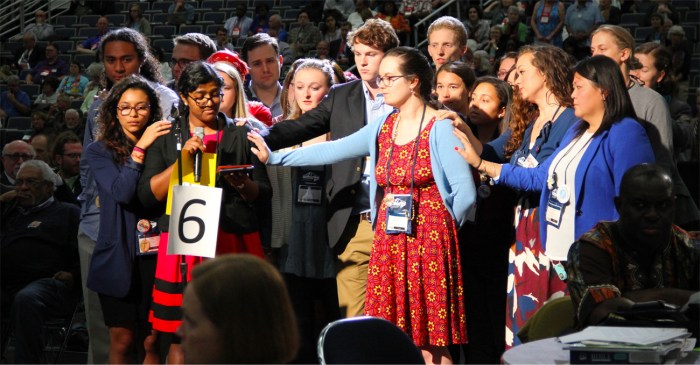
Something difficult but significant happened today. In the mid-afternoon, a group of nearly 100 United Methodists facilitated an unscheduled demonstration. They paraded through the plenary room, chanting “Black lives matter!” and carrying a banner that read, “All Black Lives Matter: bisexual, transgender, poor, heterosexual, lesbian, gay, disabled, women, men, youth and children.” As reporter Jessica Brodie described it,

 The marchers included members of various groups, including Black Methodists for Church Renewal, the Love Your Neighbor Coalition, the  Reconciling Ministries Network and Love Prevails…They marched twice   around the floor, chanting, ‘No more hate’ and ‘Hey, hey, ho, ho, homophobia’s  got to go.’ They ended at the center table for proclamation and song before marching out.

It was a moment that once again made clear the deep divide in our denomination over human sexuality in general and United Methodism’s stance on homosexuality in particular—a divide that will no doubt find further expression in upcoming legislative conversations.

Please, as you read my description of what transpired during today’s demonstration, I implore you not to allow yourself to become cynical, belligerent, or combative. Today’s demonstration, after all, came from the hearts of people who love Jesus dynamically and who believe wholeheartedly that the church’s current teaching on homosexuality is as harmful as it is misguided. Even if one disagrees strongly with their conclusions, one can at least be respectful of their deeply held convictions. I would greatly appreciate the avoidance of vitriolic debate in this medium (since I am already finding quite enough of that here in Portland). I describe today’s demonstration in detail only because I want you to understand with greater clarity the scope of what lies before us as a church.

During this afternoon’s demonstration, members of the Western Pennsylvania delegation, along with some guests, formed a circle, joined hands, and prayed silently. It was all we could think to do. The emotional intensity of the demonstration, I think, was starkly but meaningfully unsettling to all of us. For what did I pray in the silence? I prayed for a church that never loses its passion for both holiness and justice. I prayed for peace in our world, our nation, our church, and the plenary floor of General Conference. Most of all, I prayed that Jesus would continue to help United Methodism to find its way through our divisions in a manner that treats human lives with radical compassion; that honors Scripture with a spirit of attentive obedience; and that reflects a supernatural love that infuses even our most difficult relationships and conversations.

Thanks for reading. Thanks for praying. Thanks for being there.

Pentecost and Day Six of General Conference

IMG_0685

It has been a day of rest.  A day of Sabbath.  A day without legislation and large crowds and layered conversations.  It is Pentecost, after all, and Pentecost is a time for pausing and allowing God’s Holy Spirit to make his rejuvenating and transformational presence known.  Tomorrow, we will re-enter the rhythms of legislative conversation and administrative responsibilities, which have their own significance.  Today, however, we step away from polity and protocol in order to allow the Holy Spirit to fall afresh upon our busy minds, our weary hearts, and our fragmented lives.

At this, the midway point in an eleven-day conference, my introversion has begun to organize a coup d’état on the rest of my temperament.  When that happens, crowds begin to feel claustrophobic.  Voices begin to lose their uniqueness.  Responsibilities begin to feel oppressively heavy.  The only doorway out of the exhaustion is prayerful solitude, which is precisely what I have experienced today.  This morning, I traveled to the 10:00 service of worship that was held in one of the ballrooms of the convention center.  A number of gifted and gracious souls led us in worship. The music there celebrated the Holy Spirit’s redemptive agency throughout history.  The Scripture and proclamation painted a vivid portrait of a God who breathes the Divine Breath into even the most painful segments of our journey.  The celebration of the Lord’s Supper brought me to tears as I looked around the room and saw people from different parts of the world, speaking different languages but partaking of one bread, one cup, one Spirit with a unifying gratitude.

The words on the front of this morning’s worship bulletin were these: “Come and Find the Quiet Center.”  It feels to me like the Holy Spirit met me there—right there in the “quiet center” where Father, Son, and Sprit experience a sweetly intimate fellowship with one another and with the souls that will dare to pause there and be still.

This afternoon has been wonderfully quiet and prayerful.  Apart from an enlivening conversation with Tara (whom I desperately miss), the only other voice to which I have attempted to listen is that of the One whose love does not depend upon my accomplishment and whose grace makes it completely unnecessary for me to hide my own brokenness.

This evening, I will gather with the members of Western Pennsylvania’s delegation at a nearby restaurant for a time of bread-breaking, laughter, and playful engagement.  It will be a wonderful way to step out of the solitude that I am currently experiencing.

As I reflect upon the Scripture from Acts 2 that I heard proclaimed this morning, it occurs to me that perhaps the most miraculous thing about what the disciples experienced at Pentecost was not the rush of wind or the flames or even the spontaneous languages. Perhaps the most miraculous thing was that a new era was being initiated—an era in which people would be valued and measured differently. Gender would no longer limit the full expression of a person’s giftedness, since, after Pentecost, both “sons AND daughters” would now prophesy God’s Truth. Age would no longer be a disqualifying factor, since both the very old and the very young would experience God’s “dreams and visions.” Humble servants and marginalized people, instead of being cavalierly dismissed, would now be recognized as precious souls through whom God could accomplish miraculous things. Herein lies the deepest miracle of Pentecost. It is the miracle of the Holy Spirit ushering the world into a wonderful but demanding new reality in which people are valued, not because of their gender, their age, their station, or their ability to dominate, but because of their giftedness, their sacred worth, and their willingness to be obedient to God’s life-altering call in Jesus Christ. Come, Holy Spirit!