Window

This is a song that comes from my conviction that the precious gift of faith is often something far grander than I allow it to be.  Interestingly, the words and metaphors of the song have been very much on my mind and heart as that portion of the body of Christ called the United Methodist Church prepares for its General Conference in Portland, Oregon (May 10-20).

Window (words and music by Eric Park)

Faith can be nothing but a means to an end
A ticket to heaven, a creed to defend
Faith can be curtains behind which we hide
A withering tree with no forest beside

Faith can be shallow when depth is required
A bed to crawl into when souls become tired
Faith can be awkward, an out-of-tune hum
A lifeless equation that leads to no sum

But when faith is a window instead of a wall
A lens to look through, not a speech to recall
If faith is the forest instead of the tree
Then nothing’s outside what the faithful can see

Faith can be cloistered, an in-house debate
An object to study, a reason to hate
Faith can be closets with things put away
A good bit of talking with nothing to say

But when faith is a lifetime instead of a day
A constant rebirth, not a token to pay
If faith is the worldview beyond the decree
Then nothing’s outside what the faithful can see

Faith is assurance of things we hope for
Faith is conviction of things we can’t see
Faith is the journey our ancestors died for
Faith is the pathway to wisdom

Faith can be nothing but a weapon to wield
A rope that is fraying, a very thin shield
Faith can be strident when love is desired
A license for judgment that’s long since expired

But when faith is a window instead of a wall
A lens to look through, not a speech to recall
If faith is the forest instead of the tree
Then nothing’s outside what the faithful can see

And when faith is a lifetime instead of a day
A constant rebirth, not a token to pay
If faith is the worldview beyond the decree
Then nothing’s outside what the faithful can see

Mixed Metaphors

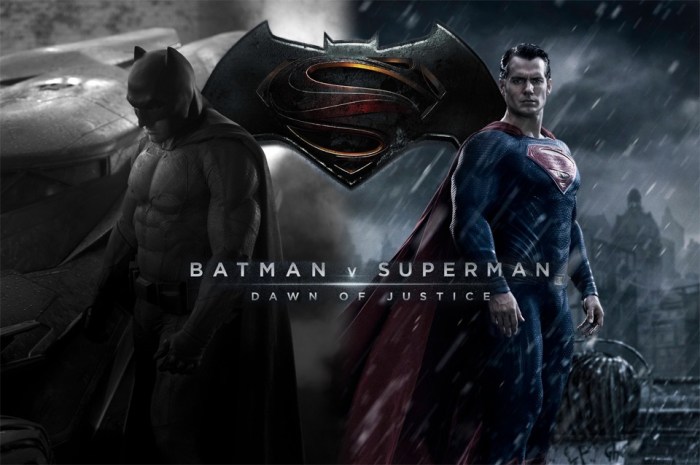
A Review of “Batman v Superman: Dawn of Justice”

In recent days, some of my comic-book reading and movie-going friends have asked me for my personal review of “Batman v Superman: Dawn of Justice.” Just for fun, here’s my review:

I am not an uncritical fanboy when it comes to superhero movies. I experienced 2006’s “Superman Returns,” for example, as a blandly derivative and wholly uninspiring addition to the Kryptonian’s narrative. Marvel’s cinematic treatment of “The Fantastic Four” has been consistently unimpressive. And don’t even get me started on “Green Lantern!”

When I say that I greatly enjoyed “Dawn of Justice,” then, it is not the hollow commendation of an undiscriminating cinephile. There have been some strongly negative reviews of the film by critics, most of which have focused on the film’s relentlessly dark mood. One critic was led to “yearn for the lighter touch of the Marvel films,” as though it were this film’s responsibility to fit into an already-established cinematic equation.
For my money, “Justice’s” unflinching grimness felt deeply purposeful and necessary given the film’s central theme: the daunting maelstrom of horror, rage, and fear in a world where terrorists obliterate crowded assemblies and where an unthinkably powerful alien from Krypton has fallen from the sky and made his power devastatingly known. This is not a children’s film, a lighthearted romp through whimsical do-gooding. Rather, the superheroes in this film are both jaundiced and uncertain of their place in the scheme of things, as are the people they are trying to help. The story feels truthful and timely, a wildly imaginative exploration of the commingling of doubt and faith, despair and hope, vulnerability and power. The film is bombastic and fervently earnest, driven both by the conviction that heroism is always costly and the realization that easy giggles are hard to come by when the world is at stake.

To say that “Dawn of Justice” is a ferocious epic is not an overstatement. For two-and-a-half hours, I was challenged by the film’s deft stewardship of its narrative, engaged by its expansive and unsettling storyline, and moved by its commitment to its characters. Affleck’s Batman silences the naysayers who doubted that he could don the cowl with integrity. He broods with meaningful urgency and fights like a ninja. Cavill’s Superman is appropriately noble and tortured. Gadot’s Wonder Woman allows a mysterious charisma to complement her warrior spirit. And Lex Luthor? Jesse Eisenberg infuses his villainy with the kind of nuance and intensity that communicates an agonizing journey into madness.

In the words of Bruce Wayne, “How many good guys are left? How many stay that way?” “Dawn of Justice” is a sweeping and finely-crafted film that explores those very questions.

batman-v-superman-dawn-justice-post1

Zestfully Clean!

What do we find in Acts 11:1-18? Many things. An Apostle named Peter. A bitter division between portions of humanity. An unsettling vision of animals, deemed “unclean” by long-obeyed laws, gathered together in a sheet coming down from the sky. Then a voice from heaven, articulating the unthinkable: “Go ahead and embrace these animals. For what I have created to be clean you must not call unclean.”

As I spend time with Peter’s vision, it has never been clearer to me that it is less a vision about animals than it is about people. Divided people. Hurting and broken people. People who have come to believe that they are “unclean” or “unseen” or “untouchable” or “unloved.” The vision is God’s way of announcing to Peter, to the church, and to us, that Jesus has transformed the human network of relationships and reconfigured the “clean/unclean” dynamic so that we are now free to look upon every single person we encounter as a precious and beloved image-bearer of the divine heart whom God created to be (zestfully) clean, whether the person is honoring that cleanness or not.

It is a vision that gives me hope for my life, for a fractured world, and for a divided church. When I am most tempted to demonize, disparage, or dismiss the person on the other side of the issue or argument, or when I am closest to consciously or subconsciously categorizing someone as unworthy of my compassion or attention, Jesus invites me to make the redemptive journey back to Peter’s revolutionary vision and its new way of conceptualizing the world and its people: “What I have created to be clean you must not call unclean.”

vision