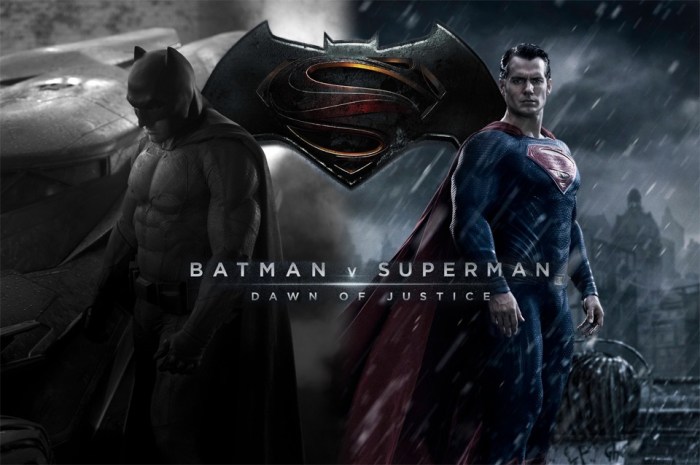
In recent days, some of my comic-book reading and movie-going friends have asked me for my personal review of “Batman v Superman: Dawn of Justice.” Just for fun, here’s my review:
I am not an uncritical fanboy when it comes to superhero movies. I experienced 2006’s “Superman Returns,” for example, as a blandly derivative and wholly uninspiring addition to the Kryptonian’s narrative. Marvel’s cinematic treatment of “The Fantastic Four” has been consistently unimpressive. And don’t even get me started on “Green Lantern!”
When I say that I greatly enjoyed “Dawn of Justice,” then, it is not the hollow commendation of an undiscriminating cinephile. There have been some strongly negative reviews of the film by critics, most of which have focused on the film’s relentlessly dark mood. One critic was led to “yearn for the lighter touch of the Marvel films,” as though it were this film’s responsibility to fit into an already-established cinematic equation.
For my money, “Justice’s” unflinching grimness felt deeply purposeful and necessary given the film’s central theme: the daunting maelstrom of horror, rage, and fear in a world where terrorists obliterate crowded assemblies and where an unthinkably powerful alien from Krypton has fallen from the sky and made his power devastatingly known. This is not a children’s film, a lighthearted romp through whimsical do-gooding. Rather, the superheroes in this film are both jaundiced and uncertain of their place in the scheme of things, as are the people they are trying to help. The story feels truthful and timely, a wildly imaginative exploration of the commingling of doubt and faith, despair and hope, vulnerability and power. The film is bombastic and fervently earnest, driven both by the conviction that heroism is always costly and the realization that easy giggles are hard to come by when the world is at stake.
To say that “Dawn of Justice” is a ferocious epic is not an overstatement. For two-and-a-half hours, I was challenged by the film’s deft stewardship of its narrative, engaged by its expansive and unsettling storyline, and moved by its commitment to its characters. Affleck’s Batman silences the naysayers who doubted that he could don the cowl with integrity. He broods with meaningful urgency and fights like a ninja. Cavill’s Superman is appropriately noble and tortured. Gadot’s Wonder Woman allows a mysterious charisma to complement her warrior spirit. And Lex Luthor? Jesse Eisenberg infuses his villainy with the kind of nuance and intensity that communicates an agonizing journey into madness.
In the words of Bruce Wayne, “How many good guys are left? How many stay that way?” “Dawn of Justice” is a sweeping and finely-crafted film that explores those very questions.