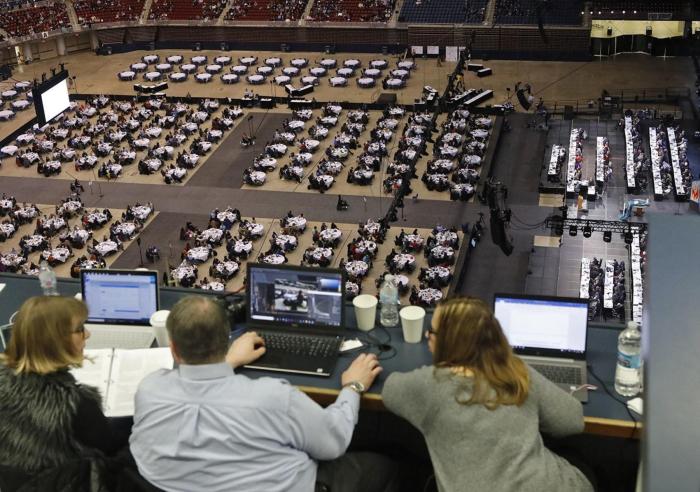
United Methodist General Conference 2019—Day 3

5c7489bab2cee.image

(photo by J.B. Forbes)

It was a very painful day. Some of us agreed that it felt like there was a spirit of death in the place, no matter where people stood in their convictions. And I felt complicit in it.

The day started with worship, during which we prayed words together that ushered me into a deeper conceptualization of the faith by which I long to walk:

Faith can be cloistered, an in-house debate
An object to study, a reason to hate
Faith can be closets with things put away
A good bit of talking with nothing to say

But when faith is a lifetime instead of a day
A constant rebirth, not a token to pay
If faith is the worldview beyond the decree
Then nothing’s outside what the faithful can see
No, nothing’s outside what the faithful can see

As we offered those words in unison, it was a moment of personal repentance for me, an opportunity to carry to the cross my tendency to reduce discipleship to a matter of debate—a fresh chance to lay at Jesus’ feet my “good bit of talking with nothing to say.” I quietly prayed that this Christ-follower (and Christ’s church) would become more passionate about seeing faith as a lifetime journey instead of an episodic paying of a spiritual token.

The General Conference spent the entire day engaging in its work as a LEGISLATIVE COMMITTEE. This requires just a moment of procedural explanation. In the work of a more typical General Conference, the delegates are divided into several smaller legislative committees. Each one of these smaller committees is assigned a variety of petitions categorized under a particular ministry area (Church and Society; Higher Education; Faith and Order; Discipleship; Financial Administration; Global Ministries; General Administration; Local Church; Superintendency; etc.) The purpose of each legislative committee in a typical General Conference is to review and refine the legislation assigned to it and then to make a recommendation to the entire General Conference which would then take final action on the legislation.

In this special called session of the General Conference, since all of the legislation is somehow related to deliberation about the denomination’s Way Forward, the decision was made to have just one legislative committee to which all of the delegates would be assigned. In other words, the plan was for the entire General Conference to become a legislative committee for a designated period of time, so that all of the delegates could work on refining the legislation and then vote on what legislative recommendations to carry into the plenary session.

Today, the General Conference engaged in its work as a legislative committee, addressing all of the legislation entrusted to its care. The deliberation and debate were frequently difficult and, at times, excruciatingly painful. The delegates, some with extraordinary vulnerability, all with passionate conviction, shared their stories, their hopes, their fears, and their perspectives, all for the purpose of determining legislative recommendations that will demand final action at tomorrow’s plenary session.

Here is where it gets painful.

As a legislative committee, delegates ultimately took the following actions:

  • Supported the Traditional Plan—meaning that the Traditional Plan (which both maintains and intensifies the denomination’s current ban on same sex weddings and ordination) will come to tomorrow’s plenary session for final vote
  • Opposed the One Church Plan, the Connectional Conference Plan, and the Simple Plan, all of which would have removed the Discipline’s current language related to homosexuality and created safe space for a wide variety of convictions within the denomination  (There is a chance that the One Church Plan might find its way into tomorrow’s plenary session, but this will require the approval of a minority report, which is an uphill battle in this case.)
  • Supported two disaffiliation proposals which would institute a process by which United Methodist churches could leave the denomination with their property
  • Requested a ruling from United Methodism’s Judicial Council on the constitutionality of the Traditional Plan (about which delegates should receive information tomorrow)

What am I able to say about all of this by way of personal reflection? Not much at this point. I am weary and burdened—even broken—tonight.

Many traditionalist United Methodists view today’s legislative actions as a necessary preservation of what they believe to be a timeless Biblical teaching on marriage and sexuality. (I am praying, however, that their hearts will not permit them to rejoice, given the devastation that others in the denomination are experiencing.)

I also realize that many people in the United Methodist portion of the body of Christ are weeping tonight. Weeping because they no longer know what their place is in the church. Weeping because they feel isolated, excluded, abandoned, even demonized. Weeping because they believe that Jesus is walking with them but that his church isn’t.

All evening long, I have been reaching out to people in my life who most likely experienced today’s legislative actions as something hurtful. I encourage you to be attentive to those same people in your life. They are there, after all, probably somewhere nearby, hurting and uncertain, wondering if you see them—really see them—and wondering if you really care.

I am not inviting debate with this post (since there has been enough of that already). I guess more than anything else, I am inviting your desperate prayer for the United Methodist tribe. Irrespective of your theological stance, allow yourself to be heartsick, tearful, and undone by the anguish of a church that is fractured but hopeful; broken but beautiful; sinful but messily and awkwardly sanctified.
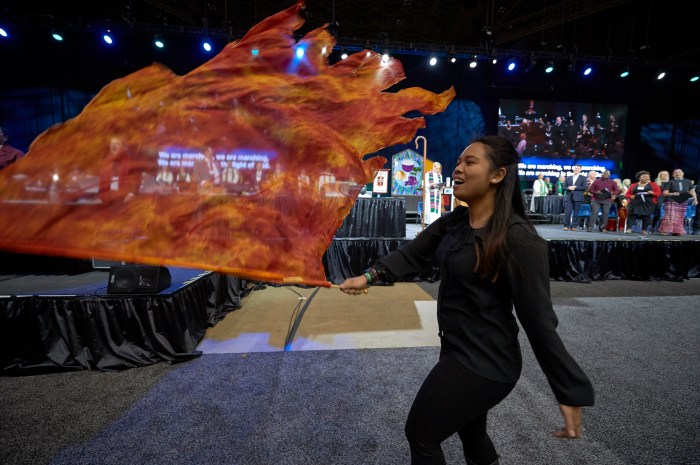
United Methodist General Conference 2019—Day 2

Paul Jeffrey United Methodist New

(photo by Paul Jeffrey, United Methodist News Service)

Sunday morning worship at General Conference today was richly evocative and unsettlingly thought-provoking. Bishop Kenneth Carter, President of the Council of Bishops, preached in a manner that built a creative bridge between the Biblical imagery of transformation and the present challenges facing United Methodism. Bishop Carter began the sermon in this fashion:

If you take a moment to look around the room, it will become clear to you very quickly that your story is not the only story…The good news is that God has a story too. It is the story of a God who salvages what we have discarded and redeems what we have labeled unclean…God’s story is about creation.

Bishop Carter went on to share his personal memories of how the churches that he served became contexts of reconciliation that bore witness to God’s ability to create astonishing unity amid stark diversity:

Some of the most conservative and progressive people I have ever known occupied the churches I served as a pastor. They sang in the choir together. They cared for the homeless together. They served on committees and studied the Bible together…And when they disagreed on the interpretation of Scripture (imagine that!), they looked for the heart of the person with whom they disagreed, reminded themselves of their shared dependency upon the saving grace of Jesus, and stayed together…Can God do this again? Can God abolish the dividing wall between two communities? Could these be three days during which Jesus might resurrect us and lead us into new life?

The cynic (and I can be one of those if I am not careful) might conclude that Bishop Carter was simply priming the pump for a conversation about the One Church Plan, which is the “Way Forward” plan endorsed by the Council of Bishops. But I experienced the sermon as something much deeper than a homiletical argument for a denominational plan. The sermon spoke a Biblical truth into my consciousness that I desperately needed to hear this morning—that the scandalous grace of Jesus has a way of keeping people together and connecting hearts across a variety of divides.

Bishop Christian Alsted, who serves as Bishop of the Nordic and Baltic Episcopal Area of the Northern Europe and Eurasia Central Conference, presided over the morning plenary. Bishop Alsted wisely and pointedly reminded us of the nature of our gathering:

This is not a football arena over the next three days [referring to the fact that we are meeting in the arena where the then-St. Louis Rams used to play]. No, for the next three days, this is Church, and we are a community shaped by the person and the work of Jesus Christ.

The rest of the morning was devoted to a presentation of the three denominational plans developed by the 32-person Commission on the Way Forward. As part of its presentation this morning, the members of the Commission reminded the delegates that the Commission’s role “was not to pick a winner or to choose a side but to explore new possibilities that magnify the United Methodist Connection.”

The three plans, already familiar to many of the people reading this post, are these:

The One Church Plan (the values of which are a generous and flexible unity, a contextuality for missional vitality, and a durable honoring of the connectional nature of United Methodism)

The Connectional Conference Plan (which is the most structurally complex of the plans but also the one that frames our future in a theology of connectionalism that envisions a “big tent” with smaller tents within it)

The Traditional Plan (which is built upon the values of unity in doctrine, consistency in practice, and an intensified accountability)

Following today’s lunch break, Bishop Hope Morgan Ward, Resident Bishop of the Raleigh Area, led the General Conference in a prioritization process, the purpose of which was to assist the General Conference in determining the order in which delegates will address the numerous legislative petitions. In this prioritization process, the 70-plus petitions were grouped based upon their content and purpose. Each “bundle” of petitions was then voted on by the delegates as being either “high priority” or “lower priority.”

The prioritization process resulted in the following “top five” legislative priorities for this General Conference:

1. Pension liability petitions from Wespath (United Methodism’s pension and benefits agency)

2. The Traditional Plan (and its related petitions)

3. A proposed disaffiliation process (i.e., a means by which to exit the denomination)

4. A second proposed disaffiliation process

5. The One Church Plan (and its related petitions)

Voices from around the Connection responded to this “top five” list in different and important ways. Some lamented the fact that a concern for unfunded pension liability, as institutionally significant as that issue might be, would top the priority list. Some celebrated the high position of the Traditional Plan, believing that this indicates a majority support for the plan’s emphasis on doctrinal orthodoxy. Others lamented that the Traditional Plan was prioritized so highly, believing that its place on the list signals a continued and institutionalized injustice against the LGBTQ community. Still other voices expressed concern and sadness that two disaffiliation plans made it into the list of top five priorities.

Personally, I am uncertain of what it all means. Perhaps I am still processing and pondering the way in which the dust is settling after a long and demanding day. What is abundantly clear is that hope and heartbreak are breathing the same air at General Conference, as are traditionalists, progressives, and centrists. We are a complicated, messy, global, often-divided, and strangely beautiful tribe. I long for an authentic and durable unity that reflects a shared subordination to the Lordship of Jesus and yet remains expansive enough to avoid both theological myopia and institutional idolatry. Our corporate vision for such a thing, however, remains painfully elusive.

Having cared for the pension liability petitions this afternoon, we will turn our collective attention to the Traditional Plan tomorrow morning following worship. I anticipate the kind of extensive deliberation that ushers the delegates through the complexities of parliamentary parlance and into the vulnerable territory of differing Biblical interpretations and disparate theological convictions.

As I prepare for tomorrow, I am thanking God for the way in which this long day ended—with a time of joyful interaction and bread-breaking, shared by most of the people who are here from Western Pennsylvania (delegates and volunteers, visitors and prayer warriors). These precious souls have taught me more about faithful discipleship than they will ever be able to understand. Their voices tonight reminded me sweetly…

…that Jesus is still saving the world…

…and that our United Methodist tribe is worth the sometimes-devastating struggle.

Tonight, that is enough.

When Faith Is a Window Instead of a Wall

GC2019-St.LouisArch

Words are flowing freely and in many directions as we move into the 2019 General Conference.

Words of hope.

Words of anger.

Words of conviction.

Words of fear.

Words of unity and separation; of solidarity and schism; of galvanization and gracious exits.

Words.

I have no more words to offer, which is perhaps best. Even my prayers at this point have become wordless sighs of intercession for a church I dearly love.

So, in this blog post, instead of prosaic words, I offer something far less practical.

A song.

It is a song about faith, at its worst and best. Perhaps more descriptively, it is a song about the transformed perspective that Jesus makes possible.

I am singing the song quietly these days, in the hidden chambers of my soul, somewhere beneath all of my words. I hope that the song becomes something like breathing for me throughout the days of General Conference, so that I will be inclined to discern more windows than walls, more rebirths than tokens.

Here is the song, feebly offered. I pray that it is an encouragement to you.

Window
(Words and music by Eric Park; Performed by Tara and Eric Park)

Faith can be nothing but a means to an end
A ticket to heaven, a creed to defend
Faith can be curtains behind which we hide
A withering tree with no forest beside

Faith can be shallow when depth is required
A bed to crawl into when souls become tired
Faith can be awkward, an out-of-tune hum
A lifeless equation that leads to no sum

But when faith is a window instead of a wall
A lens to look through, not a speech to recall
If faith is the forest instead of the tree
Then nothing’s outside what the faithful can see
No, nothing’s outside what the faithful can see

Faith can be cloistered, an in-house debate
An object to study, a reason to hate
Faith can be closets with things put away
A good bit of talking with nothing to say

But when faith is a lifetime instead of a day
A constant rebirth, not a token to pay
If faith is the worldview beyond the decree
Then nothing’s outside what the faithful can see
No, nothing’s outside what the faithful can see

Faith is assurance of things we hope for
Faith is conviction of things we can’t see
Faith is the journey our ancestors died for
Faith is the pathway to wisdom

Faith can be nothing but a weapon to wield
A rope that is fraying, a very thin shield
Faith can be strident when love is desired
A license for judgment that’s long since expired

But when faith is a window instead of a wall
A lens to look through, not a speech to recall
If faith is the forest instead of the tree
Then nothing’s outside what the faithful can see

And when faith is a lifetime instead of a day
A constant rebirth, not a token to pay
If faith is the worldview beyond the decree
Then nothing’s outside what the faithful can see
No, nothing’s outside what the faithful can see

‘Tis the Season: A Reflection and a Request for Prayer Concerning the United Methodist Appointive Process

3d68364f3ee0cf714e28f9a2393baaf6

I ask for the prayers of those of you who pray.

I am honored to be part of a ministry team called the Appointive Cabinet. More specifically, it is the Appointive Cabinet of the Western Pennsylvania Annual Conference of the United Methodist Church.

This week, I am with with my Appointive Cabinet colleagues at a meeting in Erie, Pennsylvania. Part of our work at this meeting will be to clarify our vision and prepare our hearts for the upcoming “appointment season”—a yearly time of discernment in which we give focused attention to the deployment of our clergy and the making of strategic clergy appointments.

As all United Methodists know, our denomination’s unique system of appointment-making is far from perfect. At times, it groans for redemption along with the rest of creation. While engaged prayerfully and diligently by a Bishop and District Superintendents who pour nothing less than a whole heart into their work, the truth of the matter is that perspectives are sometimes limited. Discernment is sometimes distorted or incomplete. Agendas and priorities are sometimes unintentionally misplaced.

As a result, our appointment system has sometimes led to woundedness. Painful disruption. Skepticism and cynicism born from frustrations over decisions that are seen as imprudent. Frustration over what is sometimes perceived as an inequitable application or expectation of itineracy.

Some have even come to the conclusion that our appointment system is too outdated—or too broken—to be effective any longer.

I am not debating that matter here, nor am I inviting such a debate.

I will simply share with you a perspective that my wife Tara offered to me several years ago. (Tara, by the way, was raised in the Baptist tradition. She lived in the same house for her entire upbringing. She had no idea that she would one day be a United Methodist—and married to an itinerant United Methodist pastor no less!) At one point, when we were approached by the Cabinet unexpectedly about the possibility of a new pastoral appointment, Tara responded in this fashion:

I like that we do not get to select where we live and serve and that congregations don’t get to select their pastors…Strange as it might sound, it feels right for us not to have that choice…So, if I have to decide between relying solely on my own ideas and relying on the discernment of a Bishop and Cabinet that have been entrusted by the church with the responsibility of determining where we are most needed, I’ll choose the Bishop and Cabinet…not because I believe that the Bishop and Cabinet are always right, but because I am more willing to trust their shared perspective than I am my own preferences. My preferences are too often twisted.

At which point I said to Tara, “Wow. You really ARE a United Methodist, aren’t you?”

I am grateful for Tara’s leadership in that moment. I return to her words often, simply because they remind me of what the United Methodist appointment system can be at its best:

Meaningfully disruptive.

Refreshingly hopeful.

Dynamically creative.

Unsettlingly adventurous.

Heartwarmingly sacrificial.

Evangelically strategic.

Imperfect, but purposeful.

Flawed, but redemptive.

Awkward, but linked to a narrative grounded in a countercultural theology of going where sent for the sake of the Gospel.

And so, I return to my initial request:

I ask for the prayers of those of you who pray.

Pray for Bishop Cynthia Moore-Koikoi, whose leadership I so deeply admire, whose integrity shapes me, and who holds the weight of appointment-making in her heart with consistent grace and wisdom.

Pray for the District Superintendents and the Assistant to the Bishop, that we might approach this appointment season with good priorities, clear vision, a right sense of our own fallenness, and a keen awareness of how deeply we are in over our heads.

Pray for those clergypersons who will be retiring this year and who are preparing for the next segment of their journey.

Pray for those clergypersons returning from seminary or licensing school, eager for what is perhaps their first full time or part time pastoral appointment.

Pray for those congregations that will experience transition in this appointment season, since such transitions often involve painful goodbyes and crucial hellos.

Pray for our appointive process, that it might become an instrument through which God equips the church to engage more comprehensively in its grand and glorious mission: To make disciples of Jesus Christ for the transformation of the world.

Thank you in advance for your ministry of prayer.

General Conference: Day Two

FullSizeRender-2

Our Western Pennsylvania delegation began the day together rather early with a time of prayer in which my friend and colleague, Pastor Bob Zilhaver, offered an important word to us about the hard, sacrificial, and redemptive work of forgiveness. In many ways, Bob’s reflection was an excellent preparation for today’s morning worship in plenary, which was, at its essence, a communal time of confession and repentance. It was a kairotic experience for me as I sat in that crowded plenary room, brought the profundity of my sin to the foot of the cross, and wept over both the gravity of my personal transgressions and the enormity of God’s forgiveness. I can’t help but wonder how many others had a similar experience.

Bishop Gregory Palmer then offered what I received as an exceptionally compelling Episcopal Address, which was as prophetic as it was engaging and as challenging as it was insightful. Most striking to me about Bishop Palmer’s address was his description of sanctification as “an entire life, humbled and completely delivered from our hubris and our nagging sense of self-sufficiency.” He then boldly called the General Conference to embrace its deepest purpose while at the same time rejecting misguided impulses: “We are not here in Portland to wallow in unbridled doubt, fear, and cynicism…or to lick our institutional wounds or to fixate on our shortcomings and struggles. Rather, we are here to invest ourselves completely in the discernment of the work, the ministry, and the dynamic future of what God desires for the part of the Body called the United Methodist Church.”

Bishop Palmer concluded his address by daring us not to settle for shallow or superficial relationships in the ministry of the church: “Have our relationships in the church become so superficial that we won’t even risk saying something that we might later have to go back and apologize for?!” His words awakened within me a deeper desire for a church where people stubbornly refuse to remain in the realm of anemic politeness and instead opt for the riskier, messier, and holier territory of heart to heart engagement and relational authenticity.

This afternoon was devoted to what are known as the General Conference legislative committees.  Every delegate to General Conference is part of one of twelve legislative committees, each of which does a substantial amount of work in discussing, amending, and perfecting the thousands of petitions that come before the General Conference. Think of it this way:  Without the work of the legislative committees, the plenary of General Conference would have to give detailed attention to every single petition, which would demand an additional two weeks of conferencing! The legislative committees are what help the General Conference to prioritize and administer its legislative work.  I am a part of the Discipleship legislative committee, the responsibility of which is to care for a variety of proposals concerning the language, strategy, and disciplinary paragraphs related to our denomination’s disciple-making ministries.

My day concluded with a three-hour period of training that will enable me to become a small group facilitator for a newly-proposed process of group discernment. This new process (outlined in the proposed “Rule 44”) will allow delegates to experience extended time in smaller groups (no larger than 15 people) in which the more controversial legislation (such as legislation on human sexuality) might be discussed without the pressure of an immediate vote, thereby creating a safer and (hopefully) more hospitable context in which delegates might listen to one another’s hearts before having to legislate.

What complicates this matter is that Rule 44 is not without some controversy of its own and will be voted on by plenary tomorrow. If Rule 44 is not passed, then I just spent three hours being trained for something that will not occur. No matter what happens with proposed Rule 44, however, the training that I experienced tonight will help me to be a better listener and a more competent bridge-builder in every segment of my discipleship. I am honored to have been asked to serve as a small group facilitator.

Personally, I am intrigued by Rule 44. It may have the potential to provide for delegates a unique opportunity to recognize the personhood and integrity of the people standing on the other side of the proposed legislation. Even better, it might just help us to recognize that the unity we share in Jesus Christ is far more expansive than our divisions.

Perspectives on the 2016 United Methodist General Conference

7133643253_cfb3bc42a3_b

I am honored to be serving as one of the Western Pennsylvania Annual Conference’s twelve delegates (six laity and six clergy) to the 2016 United Methodist General Conference, which will be held at the Oregon Convention Center in Portland, Oregon from May 10 through May 20.  I am praying about this event, even as I type these words.  Truth be told, I have been praying for the work of this General Conference since last September.  I know that many of you have been joining me in that prayer.

The members of Western Pennsylvania’s delegation have worked diligently, creatively, and strategically over this last year in preparation for both General Conference and July’s Northeastern Jurisdictional Conference. The members of the delegation regularly inspire me with how seriously they take the church’s ministry and how deeply they believe that the United Methodist Church still has something important to offer in the furthering of God’s kingdom.

The 864 General Conference delegates from Africa, the Philippines, Europe, and the United States will travel to Portland on or before May 10. We will be joined there by other visitors, observers, volunteers, marshals, and pages (some from Western Pennsylvania), all of whom will be there on their own dime and time, simply because they believe that something is about to happen in Portland that demands their very best efforts and attention.

General Conference, which meets every four years, is United Methodism’s highest legislative body for all matters affecting the United Methodist connection.  It is the only entity that has the authority to make decisions for the entire denomination. That may strike some of you as woefully impractical. What corporation, after all, would ever be able to be survive and thrive if its primary governance body included one-thousand people and met only once every four years?

And yet, for all of the practical and strategic questions that may be raised in any conversation about General Conference, I am deeply grateful to be part of a denomination whose authority is not centralized. No single leader, bishop, or committee has the authority to govern our church. Rather, our portion of the Body of Christ finds its governance in a praying, searching, occasionally-quarrelling, sometimes-divided, frequently-doxological quadrennial body called the General Conference. It is this historical priority of “governance by conferencing” that has enabled United Methodism to retain its emphasis on both communal discernment and communal responsibility.

We will worship vibrantly at General Conference over the course of the ten-day gathering.  Worship, in fact, is the very best part of what we will experience together. We will also turn our attention to some weighty and controversial issues, all for the purpose of doing our prayerful and discerning best to help the church to become more faithfully the church that Jesus Christ is calling it to be. These are some of the issues that we will address:

*As a General Conference, we will consider a variety of proposals related to the restructuring of the ministries of the general church. The proposal that seems to be generating the most conversation is entitled “Plan UMC Revised,” which revisits a conversation begun at the 2012 General Conference and aims to redefine the structure and the authority of the Connectional Table and to reduce the size of several general boards and agencies (while increasing representation from outside the United States). This type of legislation bears witness to our denomination’s struggle both to establish better institutional accountability on the general church level and to structure our boards and agencies in a way that mitigates institutional decline by the strategic reconfiguration of denominational ministry.

*We will make decisions related to the global nature of the United Methodist Church, including the continuing development of a global Book of Discipline. These decisions will hopefully enable the denomination to rid itself of its unfair and unrealistic US-centric bias in order to manifest a more comprehensive and expansive ecclesiology. Why is this important? Because, while American United Methodism has experienced significant decline in recent decades, the United Methodist Church in Africa has seen 200% growth over the last twenty years. There has been similar United Methodist growth in the Philippines.  In its current structure and ethos, United Methodism too often functions as though it still believes that the American church is at the unifying center of what God is doing through our denomination. The news from around the world bears witness to a different reality than this. At this General Conference, we have a unique opportunity to make several decisions that will help our denomination to incarnate a more global and globally-strategic perspective.

*We will consider proposals related to licensed and ordained ministry, the most compelling of which is the “reshaping of the ordination process.” This “reshaping” would move ordination to the front end of the process (at the time a candidate for ministry is elected to provisional membership). I would imagine that this proposal will lead to some important and challenging theological conversations about the relationship of ordination to conference membership.

*We will make important decisions about what our church will teach about human sexuality (and, in particular, homosexuality). The church’s current position is that, while all people are of sacred worth and precious to God, the practice of homosexuality is “incompatible with Christian teaching.” As a result of this discerned incompatibility, the United Methodist Church does not currently ordain self-avowed, practicing homosexuals.  Likewise, United Methodist clergy and congregations are not currently permitted to conduct same-sex unions in their sanctuaries.

There is legislation before the General Conference that recommends a change in the denominational position on homosexuality—a change that the writers of the legislation believe would make for a more inclusive and compassionate church. Alternatively, there is legislation before the General Conference that would protect—and fortify—the denomination’s current position on homosexuality. We will also consider a “compromise proposal” that would remove the restrictive language from the Discipline and would leave the discernment to individual pastors, congregations, and annual conferences. Perhaps most alarmingly, there is legislation that outlines an “amicable separation” in the United Methodist denomination between those who advocate for a Disciplinary change related to the church’s teaching on homosexuality and those who wish to retain our denomination’s current position.

My prayer is that, as the General Conference makes important decisions related to the church’s teaching on human sexuality, we might resist the temptation to become so idolatrous about one side of the issue or the other that we lose sight of the fact that, for disciples of Jesus, human sexuality is not fundamentally a controversy to be debated. It is rather a sacred gift to be stewarded and sanctified in a way that bears witness to a dual commitment to sexual holiness and authentic compassion.

*We will consider a proposal for a new United Methodist Hymnal. The proposal is designed to maximize flexibility and usability by making the approved “canon of song and ritual” accessible in a variety of electronic formats. Also included in this proposal is the formation of a standing Hymnal Advisory Committee, the work of which would be to evaluate and recommend additional song and ritual resources for future inclusion. This will give to the hymnal the sense of being a perpetual work in progress. Historically, liturgical flexibility has been a difficult thing for an institutional church to generate. This proposal for an electronically-available and regularly-expanding hymnal may very well represent positive movement in that regard.

I hope to write and share posts throughout my experience at General Conference—if not for your benefit, then for mine (since this kind of writing is a form of public journaling for me, a cathartic discipline of praying and discerning and “working out my own salvation in fear and trembling”).

I know that many of you are already holding the General Conference, its volunteers, its organizers, and its delegates in your prayerful heart. I would be grateful if even more of you added your voices to the ministry of prayer that General Conference so desperately needs. Pray for the delegates and volunteers. Pray that people on opposite sides of a variety of issues will cultivate the ability to see the face of Jesus in one another. Pray for a spirit of deep discernment, patient attentiveness, and compassionate engagement. Most of all, pray for that portion of the body of Christ called United Methodism, that we might be a church that is as committed to holiness as it is to compassion; as devoted to justice as it is to love; and as passionate about sanctification as it is about Biblical truth.

IMG_0620