General Conference: Day Five

FullSizeRender

My friend and colleague, John Seth, led our delegation early this morning in a time of prayer and reflection. John encouraged us to follow the prophet Jeremiah’s instruction to find “where the good way lies” and to “walk in it.”

At General Conference, my sense is that God’s “good way” often gets distorted by things like pace, tone, presuppositions, weariness, and woundedness. For me, then, God’s “good way” is the way of a carefully-managed tempo, a patient rhythm of prayer, and an ever-deepening attentiveness to the present moment, so that the people I encounter don’t slip through the cracks of my personal agenda and so that my own heart does not get lost in the frenzy of all that I want to accomplish.

Bishop Sudarshana Devadhar preached at the morning worship service today, focusing, interestingly, on the Wise Men’s visit to Jesus. “Like the Wise Men of old,” Bishop Devadhar said at one point, “will we experience the epiphany of God’s glory in Christ and travel home by a different road? Will we open ourselves to the direction of God so that we might hear the Great Commission—‘Go, therefore…’—as a mandate to travel by an alternative pathway, declaring the Epiphany of Jesus Christ to the world?

An important part of our morning was the Young People’s Address, offered by Chelsea and Peter. Chelsea is a young adult from Delaware (now living in Michigan), who became Christian because of the radical hospitality of her United Methodist Church, where “everyone was welcomed and loved as image-bearers of God.” Peter is a young adult from the Republic of the Congo, who was raised Muslim, came reluctantly to a United Methodist Church for worship and, after a season, became a Christ-follower because of the pastor’s consistent preaching about “the transforming power of God’s forgiveness and grace.

As I experienced the Young People’s Address this morning, it became abundantly clear to me how desperately the church needs its young adults, whose leadership is urgent, whose presence and absence are all-too-often ignored, whose voices are waiting to be heard and valued, and whose love for Jesus is something dynamically grand. Peter, one of today’s presenters, described the life of Jesus in a compelling manner: “Jesus, the Savior of the world. Jesus, the Servant Leader. Jesus…the young adult.

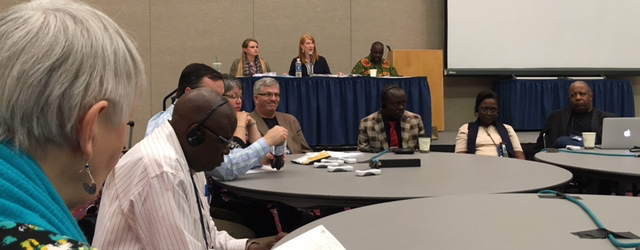
I spent the rest of today (until 9:30 this evening) in my Discipleship legislative committee, sitting at a table with the three young people pictured above. We were able to finish our work. We vetted and perfected legislation that will come before the entire General Conference next week for final action. The legislation entrusted to our committee addresses several important matters: the creation of a new United Methodist Hymnal, available in multiple formats; reducing the risk of child abuse in the church; expanding young adult ministry in the United Methodist connection; addressing teen suicide; clarifying both the strategy and the language for the training and equipping of the laity; and fortifying the ministry of both the “Native American Comprehensive Plan” and the “Strengthening the Black Church for the 21st Century” initiative.

There were several moments throughout today’s work with the legislative committee when I experienced the joyful sense that I was participating in something meaningful and redemptive—something that would lead to the betterment of God’s church.

It felt good.

General Conference: Day Four

FullSizeRender-3

My friend and colleague, Rev. Amy Wagner, led our delegation early this morning in a time of prayer and reflection. Amy borrowed an image from Richard Rohr—specifically, the image of “replanting grace”—to move us more deeply into a contemplation of where it is in our own individual lives that we most desperately need a fresh “replanting” of God’s life-giving grace.

Personally, I am most in need of a grace-filled replanting in my pastoral ministry and leadership. More specifically, I long for a new experience of grace that will generate within me a healthier confidence in spite of my inadequacies; a healthier joy in spite of my self-doubt; and a healthier vision in spite of my deficiencies in leadership. My prayer this morning became something like this: “Replant within me, O God, a grace that will equip and inspire me to be a faithful pastor and friend to the exceptional congregation that I am privileged to serve.”

In today’s morning worship service, Bishop Sally Dyck offered a provocative sermon that challenged all of us to “go learn mercy.” What made Bishop Dyck’s sermon particularly noteworthy was her allusion to the fact that “only one category of people do we declare to be incompatible with Christian teaching” (a reference to the United Methodist Book of Discipline’s language about the practice of homosexuality). Bishop Dyck went on to express her desire that nothing (or no one) be singled out in the Book of Discipline as being “incompatible with Christian teaching” and that we would all recognize our shared fallenness and our shared need for God’s saving grace.

For those who desire a change in the church’s current teaching related to homosexuality, Bishop Dyck’s proclamation came as a liberating word of profound hope. For those who support the denomination’s current position, however, the Bishop’s words sounded more like a stark dishonoring of a long-held denominational conviction related to the stewardship that one is to practice over his or her sexuality.

Immediately following Bishop Dyck’s sermon, I engaged in a conversation with some of my colleagues. The conversation focused on hard things: the difference between mercy and acceptance of a particular behavior; the crucial connection between compassion and accountability; the demanding relationship between the pursuit of holiness and the language of “incompatibility.” In many ways, the conversation I experienced today was a reflection of the larger struggle in which our denomination currently finds itself. Bishop Dyck’s sermon took us straight to the broken heart that beats somewhere in the middle of that struggle.

It may be that some of you who are reading this are deeply and meaningfully troubled and unnerved because you have never experienced a church gathering in which human sexuality was so specifically named and debated. Or maybe you are seeing disruptive social media sound bites in the Facebook news feed that leave you wondering why the church is focusing on these matters. If this describes you at all, please know that I am prayerfully standing alongside you in the journey; that Jesus Christ is still Lord of creation and head of the church; and that God will provide a way through that is grounded in radical patience, relentless compassion, and profound obedience. Hang in there, friends. Jesus is in the messiness of all of this, doing something creatively redemptive and good.

The highlight of the day for me was the Laity Address in which a number of beautifully-gifted lay persons reminded us afresh that, if there is going to be authentic revival in the church, it will come, not primarily through the clergy, but through the laity. It has always been that way throughout the church’s history. Particularly moving today was the testimony of 14-year-old Hannah Foust, who stood before the entire General Conference and described the manner in which her heart was drawn to the suffering of many people in the West African country of Burkina Faso, where sources of clean water are scarce. Through her individual efforts, Hannah has funded three wells in Burkina Faso, thereby providing clean water for thousands of people. Her motivation? “Jesus, the Living Water, has called me to change the world through funding wells. He brought people from the other side of the world into my heart, and he is using me to help them in their hurting.

Yep. That’s Jesus. That’s church.

I spent about six hours in my Discipleship legislative committee this afternoon. We acted on about 1/3 of the 52 petitions that have been entrusted to our care, which is an excellent start. The work that we did today as a legislative committee will lead to better and clearer training for lay persons who feel called to deepen their ministry. Beyond this, we clarified legislation that will hopefully result in life-changing ministry through the Native American Comprehensive Plan and an important initiative called “Strengthening the Black Church for the 21st Century.”

The evening concluded with a beautiful banquet that celebrated the ministry of the laity of the United Methodist Church. As I sat at the banquet, weary and deep in thought, it occurred to me how blessed I am to know Jesus and to experience the remarkable things that he is doing through his people.

General Conference: Day Three

IMG_0674-2 (1)

At our delegation’s time of prayer and conversation early this morning, Paul Morelli read to us some weighty words from pastor and author A.W. Tozer. Tozer’s words ushered us into a contemplation of the perpetual nearness of the sin of idolatry. According to Tozer, idolatry is not limited to the glorification of a literal, physical idol. Rather, idolatry is the willingness to abandon our “lofty opinion of God” in order to settle for an image of God that somehow truncates the greatness, the holiness, and the beauty of God’s character. As Tozer puts it, “the first step down for any church is taken when it surrenders its high opinion of God.”

I wonder, where do I sell God short in the way I conceptualize God? In the way that I pray? In the way that I make God less than God in my deepest thoughts? Where have I slipped into a functional idolatry in the way I quietly reduce God to little more than a divine best buddy who winks at sin? Or a coldhearted observer who merely watching my suffering and pain from a distance? Such questions bring me to the heart of an idolatry that I commit all to frequently. This morning’s devotions helped me to name and confess it.

At our morning worship service in the plenary room, Bishop Christian Alsted, of the Nordic and Baltic Episcopal Area, preached a powerful sermon that centered on Jesus’ encounter with a Roman centurion in Matthew 8—a soldier who is crying out to Jesus for a healing on behalf of his servant. Bishop Alsted suggested that this soldier’s counter-cultural willingness to reach out to Jesus is a Biblical reminder to us that the starting point of our deepest transformation, “is a willingness to subordinate ourselves to the revolutionary authority and healing power of Jesus Christ and to depend upon him for the healing of our church.” The Bishop’s words brought the Gospel afresh to my heart. It was an enlivening way to begin the day.

The remainder of the morning was devoted to a lengthy conversation and debate around proposed Rule 44, which I referenced in my last post. Just to remind you of the particulars, Rule 44, if approved, would have allowed delegates to experience extended time in smaller groups (no larger than 15 people) in which the more controversial legislation (such as legislation on human sexuality) might be discussed without the pressure of an immediate vote, thereby creating a safer and (hopefully) more hospitable context in which delegates might listen to one another’s hearts before having to legislate. It was a long and, at times, frustrating discussion about Rule 44 in today’s plenary—frustrating because of procedural quagmires and technological uncertainties related to who was permitted to speak and for what purpose. When it finally came to a vote, the Rule 44 proposal was rejected, 477-355.

Clearly, the General Conference was not ready to say a collective yes to this new process of discernment. While I respect the plenary’s decision, I am also saddened by it. The rejection of Rule 44 leaves me wondering where and when our denomination will create contexts for safe and desperately-needed conversations about hard and complex issues. At present, we seem to be far more eager to legislate our position than we are to listen to one another—far more passionate about casting a vote than we are about engaging the hearts of those who see things differently than we do. I love the United Methodist Church and it’s emphasis upon personal and social holiness, its devotion to personal piety and public acts of mercy, and its Christocentric vocabulary of grace. But there are issues before us that demand deeper conversations than a legislative plenary can accommodate. I was hoping that Rule 44 might have at least opened the door to such conversations, thereby enabling us to love one another more attentively, irrespective of the final legislative decision.

This afternoon and early evening were devoted to the work of the twelve legislative committees. All afternoon long, the 80-plus members of my legislative committee (Discipleship) were tremendously patient and gracious in dealing with one another as we settled into a shared process and a common approach.  It felt like the way church ought to be—a roomful of Jesus-followers who were willing to allow themselves to be slowed down for the sake of making certain that everyone present understood what was being said and what was being done.  It felt like a gathering of imperfect saints who were willing to subordinate expediency to relational attentiveness.  I was honored to be a part of it.


General Conference: Day Two

FullSizeRender-2

Our Western Pennsylvania delegation began the day together rather early with a time of prayer in which my friend and colleague, Pastor Bob Zilhaver, offered an important word to us about the hard, sacrificial, and redemptive work of forgiveness. In many ways, Bob’s reflection was an excellent preparation for today’s morning worship in plenary, which was, at its essence, a communal time of confession and repentance. It was a kairotic experience for me as I sat in that crowded plenary room, brought the profundity of my sin to the foot of the cross, and wept over both the gravity of my personal transgressions and the enormity of God’s forgiveness. I can’t help but wonder how many others had a similar experience.

Bishop Gregory Palmer then offered what I received as an exceptionally compelling Episcopal Address, which was as prophetic as it was engaging and as challenging as it was insightful. Most striking to me about Bishop Palmer’s address was his description of sanctification as “an entire life, humbled and completely delivered from our hubris and our nagging sense of self-sufficiency.” He then boldly called the General Conference to embrace its deepest purpose while at the same time rejecting misguided impulses: “We are not here in Portland to wallow in unbridled doubt, fear, and cynicism…or to lick our institutional wounds or to fixate on our shortcomings and struggles. Rather, we are here to invest ourselves completely in the discernment of the work, the ministry, and the dynamic future of what God desires for the part of the Body called the United Methodist Church.”

Bishop Palmer concluded his address by daring us not to settle for shallow or superficial relationships in the ministry of the church: “Have our relationships in the church become so superficial that we won’t even risk saying something that we might later have to go back and apologize for?!” His words awakened within me a deeper desire for a church where people stubbornly refuse to remain in the realm of anemic politeness and instead opt for the riskier, messier, and holier territory of heart to heart engagement and relational authenticity.

This afternoon was devoted to what are known as the General Conference legislative committees.  Every delegate to General Conference is part of one of twelve legislative committees, each of which does a substantial amount of work in discussing, amending, and perfecting the thousands of petitions that come before the General Conference. Think of it this way:  Without the work of the legislative committees, the plenary of General Conference would have to give detailed attention to every single petition, which would demand an additional two weeks of conferencing! The legislative committees are what help the General Conference to prioritize and administer its legislative work.  I am a part of the Discipleship legislative committee, the responsibility of which is to care for a variety of proposals concerning the language, strategy, and disciplinary paragraphs related to our denomination’s disciple-making ministries.

My day concluded with a three-hour period of training that will enable me to become a small group facilitator for a newly-proposed process of group discernment. This new process (outlined in the proposed “Rule 44”) will allow delegates to experience extended time in smaller groups (no larger than 15 people) in which the more controversial legislation (such as legislation on human sexuality) might be discussed without the pressure of an immediate vote, thereby creating a safer and (hopefully) more hospitable context in which delegates might listen to one another’s hearts before having to legislate.

What complicates this matter is that Rule 44 is not without some controversy of its own and will be voted on by plenary tomorrow. If Rule 44 is not passed, then I just spent three hours being trained for something that will not occur. No matter what happens with proposed Rule 44, however, the training that I experienced tonight will help me to be a better listener and a more competent bridge-builder in every segment of my discipleship. I am honored to have been asked to serve as a small group facilitator.

Personally, I am intrigued by Rule 44. It may have the potential to provide for delegates a unique opportunity to recognize the personhood and integrity of the people standing on the other side of the proposed legislation. Even better, it might just help us to recognize that the unity we share in Jesus Christ is far more expansive than our divisions.

General Conference: Day One

IMG_0648

Opening Worship for the General Conference was vibrant, multisensory, linguistically and culturally diverse, deeply Trinitarian in spirit, and relentlessly evocative in its music and imagery.  I wish that all of you could have been there.  (I understand that many of you watched the service online.)

During Opening Worship, Bishop Warner H. Brown, Jr., who served in Western Pennsylvania back in the 1970’s and who, in fact, was ordained elder in Western Pennsylvania in 1975, offered the ministry of preaching. Bishop Brown’s proclamation of the Word was a powerful reminder of the sufficiency of Jesus Christ in making ecclesiastical unity a possibility, even amid significantly different interpretations of Scripture and theological perspectives. Bishop Brown called to mind the important and sometimes tumultuous disagreements that the United Methodist Church has experienced in its 48-year history (since the 1968 merger that resulted in the creation of this denomination). “We hold on to our respective positions as dearly as we hold our own consciences,” Bishop Brown acknowledged in his preaching. “But may we also seek the path of unity as we have on other matters throughout our history. Jesus, we are here for you as a united church—united by your grace that saves us!”

Later on in the afternoon, we experienced a video presentation by Bishop David Yemba of the Central Congo Episcopal Area. Bishop Yemba spoke about the creative way in which many Africans in the Central Congo manage their conflicts. When conflict arises in the community, the conflicted parties agree to gather under a tree for the purpose of addressing the issues over which they are divided. The tree’s branches remind them of the many lives impacted by their conflict. The tree’s shade points to the refreshment of reconciliation. The tree’s trunk calls to mind the sturdiness of unity. According to Bishop Yemba, these conversations under the tree do not always lead to solutions. Frequently, they simply lead to a fresh recognition of the fact that peace can prevail without winners and losers and that unity can accommodate the absence of uniformity. Bishop Yemba then concluded with this powerful point: “Jesus Christ is the tree under which we gather.” We stand in the shade of his grace, unified but not uniform; manifesting peace, but not homogeneity. The tree metaphor fell upon my heart as something powerful, given all that is before us.

We devoted the rest of the afternoon and evening to special introductions, organizational matters, and the adoption of the rules of General Conference.  Conversations about General Conference rules are always challenging, especially for those who are not particularly conversant in the language of our polity and parliamentary procedure.  However, I am deeply grateful that there are leaders in our church who have both the skill and passion to help us to practice good stewardship over our rules and our processes. Those rules and processes are what help to create a healthy and appropriate context in which the General Conference can best do its work.

It is 11:15, and I am ready for sleep.  Thank you for joining me in this journey.

IMG_0651

A Litany for Mother’s Day

Mother's Day Photo

We hold many precious souls in our prayerful hearts on this Mother’s Day weekend.

Hear us, O God, as we open our hearts to you. 

We pray for women who are mothers—women who have dared to say “yes” to the daunting challenges of bearing or adopting or fostering children and raising them into a meaningful adulthood.

Bring grace and strength to mothers this weekend, that they might continue to love with integrity and find both joy and meaning in their motherhood.

We pray for women who gave birth to children and who then bravely released those children into the processes of adoption or foster caregiving so that new families might be created.

Draw near to these women and these new families as they experience the grief of letting go and the hope of new possibilities.

We pray for troubled relationships—for mothers who are alienated from their children and children who are alienated from their mothers.

Bring your healing peace to the hearts of those who find themselves weeping on opposite sides of a chasm of estrangement.

We pray for children grieving over the death of their mothers and mothers grieving over the death of their children.

Comfort them with the blessed assurance that, in Jesus, death is never given the final word to speak.

We pray for women who carry in their souls the deep and complicated grief of a miscarriage or multiple miscarriages.

Allow your divine tears to commingle with theirs, and hold them in the tender embrace of your healing love.

We pray for children who are abused or mistreated by their mothers and for mothers who are abused or mistreated by their children.

Intervene and help others to intervene, so that safety, repentance, forgiveness, and healing will find fresh expression in the midst of broken covenants.

We pray for women who live in the complex and often difficult aftermath of abortion.

Make your presence known to them in ways that are life-giving and restorative.

We pray for mothers who care for their children in the face of domestic abuse and the perpetual threat of violence.

Into these troubled homes bring your spirit of deliverance and transformation.

We pray for women who yearn to be mothers but who live with the anguish of an unfulfilled maternal longing.

Bring wholeness to their broken hearts and comfort to their saddened souls.

We pray with thanksgiving for all the women who have been a mothering presence in our lives, mentoring us, teaching us, forming us, disciplining us, and revealing to us the Divine Heart in their loving embrace.

We are grateful for the women who have mothered us; who have taught us what it means to love you with heart, soul, and mind; and who have shown us what it looks like to be authentically human.

Where people find delight in Mother’s Day this year, expand and deepen their spirit of joy. Where people find pain and anxiety, envelop their hurt in your healing grace. Help us to be attentive to both the pleasure and the sadness that Mother’s Day can inspire in the hearts of your people.

Through both the joy and the pain, enable us to experience afresh the goodness of your perfect and unfailing parental love. Usher us all more deeply into Jesus, whose grace covers all situations of motherhood and in whose name we gratefully pray. Amen.

Perspectives on the 2016 United Methodist General Conference

7133643253_cfb3bc42a3_b

I am honored to be serving as one of the Western Pennsylvania Annual Conference’s twelve delegates (six laity and six clergy) to the 2016 United Methodist General Conference, which will be held at the Oregon Convention Center in Portland, Oregon from May 10 through May 20.  I am praying about this event, even as I type these words.  Truth be told, I have been praying for the work of this General Conference since last September.  I know that many of you have been joining me in that prayer.

The members of Western Pennsylvania’s delegation have worked diligently, creatively, and strategically over this last year in preparation for both General Conference and July’s Northeastern Jurisdictional Conference. The members of the delegation regularly inspire me with how seriously they take the church’s ministry and how deeply they believe that the United Methodist Church still has something important to offer in the furthering of God’s kingdom.

The 864 General Conference delegates from Africa, the Philippines, Europe, and the United States will travel to Portland on or before May 10. We will be joined there by other visitors, observers, volunteers, marshals, and pages (some from Western Pennsylvania), all of whom will be there on their own dime and time, simply because they believe that something is about to happen in Portland that demands their very best efforts and attention.

General Conference, which meets every four years, is United Methodism’s highest legislative body for all matters affecting the United Methodist connection.  It is the only entity that has the authority to make decisions for the entire denomination. That may strike some of you as woefully impractical. What corporation, after all, would ever be able to be survive and thrive if its primary governance body included one-thousand people and met only once every four years?

And yet, for all of the practical and strategic questions that may be raised in any conversation about General Conference, I am deeply grateful to be part of a denomination whose authority is not centralized. No single leader, bishop, or committee has the authority to govern our church. Rather, our portion of the Body of Christ finds its governance in a praying, searching, occasionally-quarrelling, sometimes-divided, frequently-doxological quadrennial body called the General Conference. It is this historical priority of “governance by conferencing” that has enabled United Methodism to retain its emphasis on both communal discernment and communal responsibility.

We will worship vibrantly at General Conference over the course of the ten-day gathering.  Worship, in fact, is the very best part of what we will experience together. We will also turn our attention to some weighty and controversial issues, all for the purpose of doing our prayerful and discerning best to help the church to become more faithfully the church that Jesus Christ is calling it to be. These are some of the issues that we will address:

*As a General Conference, we will consider a variety of proposals related to the restructuring of the ministries of the general church. The proposal that seems to be generating the most conversation is entitled “Plan UMC Revised,” which revisits a conversation begun at the 2012 General Conference and aims to redefine the structure and the authority of the Connectional Table and to reduce the size of several general boards and agencies (while increasing representation from outside the United States). This type of legislation bears witness to our denomination’s struggle both to establish better institutional accountability on the general church level and to structure our boards and agencies in a way that mitigates institutional decline by the strategic reconfiguration of denominational ministry.

*We will make decisions related to the global nature of the United Methodist Church, including the continuing development of a global Book of Discipline. These decisions will hopefully enable the denomination to rid itself of its unfair and unrealistic US-centric bias in order to manifest a more comprehensive and expansive ecclesiology. Why is this important? Because, while American United Methodism has experienced significant decline in recent decades, the United Methodist Church in Africa has seen 200% growth over the last twenty years. There has been similar United Methodist growth in the Philippines.  In its current structure and ethos, United Methodism too often functions as though it still believes that the American church is at the unifying center of what God is doing through our denomination. The news from around the world bears witness to a different reality than this. At this General Conference, we have a unique opportunity to make several decisions that will help our denomination to incarnate a more global and globally-strategic perspective.

*We will consider proposals related to licensed and ordained ministry, the most compelling of which is the “reshaping of the ordination process.” This “reshaping” would move ordination to the front end of the process (at the time a candidate for ministry is elected to provisional membership). I would imagine that this proposal will lead to some important and challenging theological conversations about the relationship of ordination to conference membership.

*We will make important decisions about what our church will teach about human sexuality (and, in particular, homosexuality). The church’s current position is that, while all people are of sacred worth and precious to God, the practice of homosexuality is “incompatible with Christian teaching.” As a result of this discerned incompatibility, the United Methodist Church does not currently ordain self-avowed, practicing homosexuals.  Likewise, United Methodist clergy and congregations are not currently permitted to conduct same-sex unions in their sanctuaries.

There is legislation before the General Conference that recommends a change in the denominational position on homosexuality—a change that the writers of the legislation believe would make for a more inclusive and compassionate church. Alternatively, there is legislation before the General Conference that would protect—and fortify—the denomination’s current position on homosexuality. We will also consider a “compromise proposal” that would remove the restrictive language from the Discipline and would leave the discernment to individual pastors, congregations, and annual conferences. Perhaps most alarmingly, there is legislation that outlines an “amicable separation” in the United Methodist denomination between those who advocate for a Disciplinary change related to the church’s teaching on homosexuality and those who wish to retain our denomination’s current position.

My prayer is that, as the General Conference makes important decisions related to the church’s teaching on human sexuality, we might resist the temptation to become so idolatrous about one side of the issue or the other that we lose sight of the fact that, for disciples of Jesus, human sexuality is not fundamentally a controversy to be debated. It is rather a sacred gift to be stewarded and sanctified in a way that bears witness to a dual commitment to sexual holiness and authentic compassion.

*We will consider a proposal for a new United Methodist Hymnal. The proposal is designed to maximize flexibility and usability by making the approved “canon of song and ritual” accessible in a variety of electronic formats. Also included in this proposal is the formation of a standing Hymnal Advisory Committee, the work of which would be to evaluate and recommend additional song and ritual resources for future inclusion. This will give to the hymnal the sense of being a perpetual work in progress. Historically, liturgical flexibility has been a difficult thing for an institutional church to generate. This proposal for an electronically-available and regularly-expanding hymnal may very well represent positive movement in that regard.

I hope to write and share posts throughout my experience at General Conference—if not for your benefit, then for mine (since this kind of writing is a form of public journaling for me, a cathartic discipline of praying and discerning and “working out my own salvation in fear and trembling”).

I know that many of you are already holding the General Conference, its volunteers, its organizers, and its delegates in your prayerful heart. I would be grateful if even more of you added your voices to the ministry of prayer that General Conference so desperately needs. Pray for the delegates and volunteers. Pray that people on opposite sides of a variety of issues will cultivate the ability to see the face of Jesus in one another. Pray for a spirit of deep discernment, patient attentiveness, and compassionate engagement. Most of all, pray for that portion of the body of Christ called United Methodism, that we might be a church that is as committed to holiness as it is to compassion; as devoted to justice as it is to love; and as passionate about sanctification as it is about Biblical truth.

IMG_0620

Get Over Yourself

It is something that I normally have to say to myself ten or twelve times a day:  “Get over yourself!”  I try to allow it to become my prayer of surrender, my ongoing struggle to recognize that I am not the main character in the story.  What follows is something that helps me to sing my prayer.

Get Over Yourself (words and music by Eric Park)

A story’s being told that’s very old

It’s a story that we hear from birth

Fulfilling all our needs (so the story reads)

Is the essence of a walk on earth

But when the story’s all we’re fed a distortion’s bred

Idolatry of human greed

An inflated sense of “me” makes it hard to see

Things I want become the things I need

Chorus: Get over yourself

It’s not about you anyway

Why don’t you look past yourself

To see the panorama in which your life appears

In the climate of our day it’s often been our way

To define ourselves by our desires

Relentless appetite, everything’s alright

If it feeds the inner fires

But the life for which we’re made is of a different shade

It brings us to this point of view

We’re just as much defined by what we leave behind

Sacrifice is nothing new

Chorus

Before which God will I lay prostrate

At which altar will I kneel

Will I dare to be transformed

Or simply trust the way I feel

Will I recognize the claim on me

Or cater to my whims

Will my song be self-indulgence

Or will I sing the sacred hymns

There’s another story told that’s very old

About a Rock that’s now a Cornerstone

He calls us to depart with a servant’s heart

Into a life in which we’re not our own

So which story will you hold when your days grow old

By which narrative will you be claimed

The story that we live is what we have to give

It’s the legacy by which we’re named

Chorus

taraericpark